
Journal of Zhejiang Agricultural Sciences ›› 2026, Vol. 67 ›› Issue (1): 194-201.DOI: 10.16178/j.issn.0528-9017.20240877
Previous Articles Next Articles
ZHU Yuxiang1( ), CHEN Jiayi1, FEI Xufeng2, WU Yong1, REN Zhouqiao2,*()
Received:2024-11-16
Online:2026-01-11
Published:2026-01-19
Contact:
REN Zhouqiao
CLC Number:
ZHU Yuxiang, CHEN Jiayi, FEI Xufeng, WU Yong, REN Zhouqiao. Spatial-temporal variation and driving factors of cultivated land quality in Tongxiang City[J]. Journal of Zhejiang Agricultural Sciences, 2026, 67(1): 194-201.
Add to citation manager EndNote|Ris|BibTeX
URL: http://www.zjnykx.cn/EN/10.16178/j.issn.0528-9017.20240877
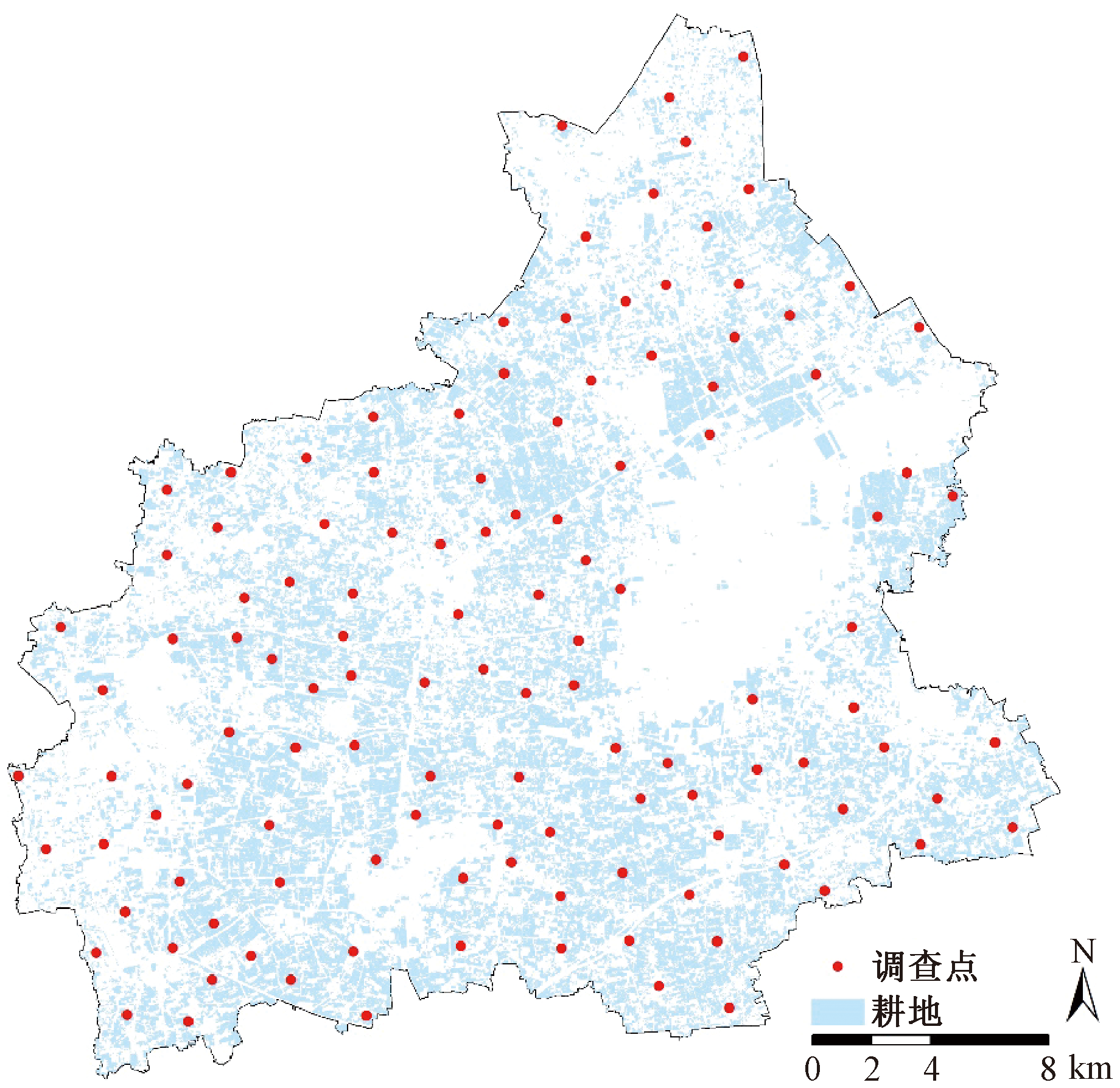
Fig.1 Distribution of investigation points in the study area
| 耕地质量等级 | 耕地质量指数 | 耕地质量等级 | 耕地质量指数 |
|---|---|---|---|
| 一等 | ≥0.917 0 | 六等 | 0.793 9~<0.818 5 |
| 二等 | 0.892 4~<0.917 0 | 七等 | 0.769 3~<0.793 9 |
| 三等 | 0.867 8~<0.892 4 | 八等 | 0.744 6~<0.769 3 |
| 四等 | 0.843 1~<0.867 8 | 九等 | 0.720 0~<0.744 6 |
| 五等 | 0.818 5~<0.843 1 | 十等 | <0.720 0 |
Table 1 Classification of cultivated land quality grades
| 耕地质量等级 | 耕地质量指数 | 耕地质量等级 | 耕地质量指数 |
|---|---|---|---|
| 一等 | ≥0.917 0 | 六等 | 0.793 9~<0.818 5 |
| 二等 | 0.892 4~<0.917 0 | 七等 | 0.769 3~<0.793 9 |
| 三等 | 0.867 8~<0.892 4 | 八等 | 0.744 6~<0.769 3 |
| 四等 | 0.843 1~<0.867 8 | 九等 | 0.720 0~<0.744 6 |
| 五等 | 0.818 5~<0.843 1 | 十等 | <0.720 0 |
| 年份 | 耕地质量指数 | 一等田比例/% | 二等田比例/% | 三等田比例/% | 四等田比例/% | 五等田比例/% | 六等田比例/% | 七等田比例/% |
|---|---|---|---|---|---|---|---|---|
| 2017 | 0.910 | 40.89 | 41.64 | 15.98 | 1.19 | 0.25 | 0.04 | 0.01 |
| 2018 | 0.913 | 34.16 | 47.24 | 16.30 | 1.93 | 0.37 | ||
| 2019 | 0.928 | 64.09 | 24.06 | 10.47 | 1.38 | |||
| 2020 | 0.947 | 98.62 | 1.38 |
Table 2 Average quality index of cultivated land and distribution of cultivated land grades in Tongxiang City from 2017 to 2020
| 年份 | 耕地质量指数 | 一等田比例/% | 二等田比例/% | 三等田比例/% | 四等田比例/% | 五等田比例/% | 六等田比例/% | 七等田比例/% |
|---|---|---|---|---|---|---|---|---|
| 2017 | 0.910 | 40.89 | 41.64 | 15.98 | 1.19 | 0.25 | 0.04 | 0.01 |
| 2018 | 0.913 | 34.16 | 47.24 | 16.30 | 1.93 | 0.37 | ||
| 2019 | 0.928 | 64.09 | 24.06 | 10.47 | 1.38 | |||
| 2020 | 0.947 | 98.62 | 1.38 |
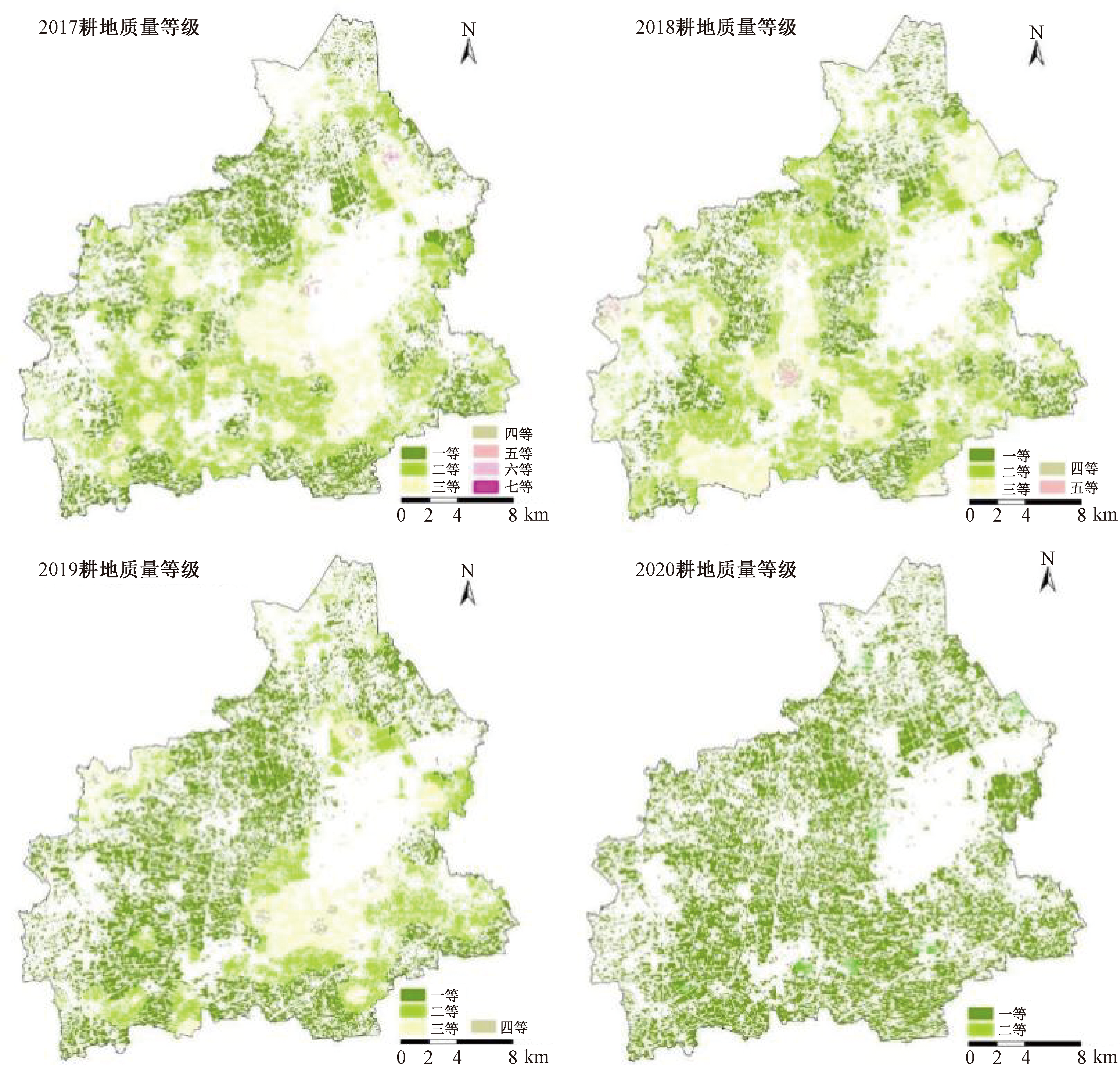
Fig.2 Distribution of cultivated land quality grades in the study area from 2017 to 2020
| 指标 | 平均值 | 变动 | ||
|---|---|---|---|---|
| 2017 | 2020 | 平均值 | 标准差 | |
| pH值 | 6.55 | 6.60 | 0.05 | 0.96 |
| 有机质含量/(g·kg-1) | 21.07 | 26.68*** | 5.61 | 13.85 |
| 有效磷含量/(mg·kg-1) | 39.29 | 58.94** | 19.65 | 68.81 |
| 速效钾含量/(mg·kg-1) | 137.14 | 185.90*** | 48.76 | 114.13 |
Table 3 Statistics on the changes in nutrient content at survey sites from 2017 to 2020
| 指标 | 平均值 | 变动 | ||
|---|---|---|---|---|
| 2017 | 2020 | 平均值 | 标准差 | |
| pH值 | 6.55 | 6.60 | 0.05 | 0.96 |
| 有机质含量/(g·kg-1) | 21.07 | 26.68*** | 5.61 | 13.85 |
| 有效磷含量/(mg·kg-1) | 39.29 | 58.94** | 19.65 | 68.81 |
| 速效钾含量/(mg·kg-1) | 137.14 | 185.90*** | 48.76 | 114.13 |
| 指标 | 回归系数 | ||||
|---|---|---|---|---|---|
| 平均值 | 中位数 | 最小值 | 最大值 | 标准差 | |
| pH值 | -0.007 | -0.003 | -0.089 | 0.060 | 0.046 |
| 有机质含量 | 0.617 | 0.618 | 0.490 | 0.743 | 0.076 |
| 有效磷含量 | 0.098 | 0.088 | 0.033 | 0.174 | 0.043 |
| 速效钾含量 | 0.318 | 0.318 | 0.052 | 0.611 | 0.172 |
Table 4 Geographically weighted regression statistics on the changes in cultivated land quality from 2017 to 2020
| 指标 | 回归系数 | ||||
|---|---|---|---|---|---|
| 平均值 | 中位数 | 最小值 | 最大值 | 标准差 | |
| pH值 | -0.007 | -0.003 | -0.089 | 0.060 | 0.046 |
| 有机质含量 | 0.617 | 0.618 | 0.490 | 0.743 | 0.076 |
| 有效磷含量 | 0.098 | 0.088 | 0.033 | 0.174 | 0.043 |
| 速效钾含量 | 0.318 | 0.318 | 0.052 | 0.611 | 0.172 |
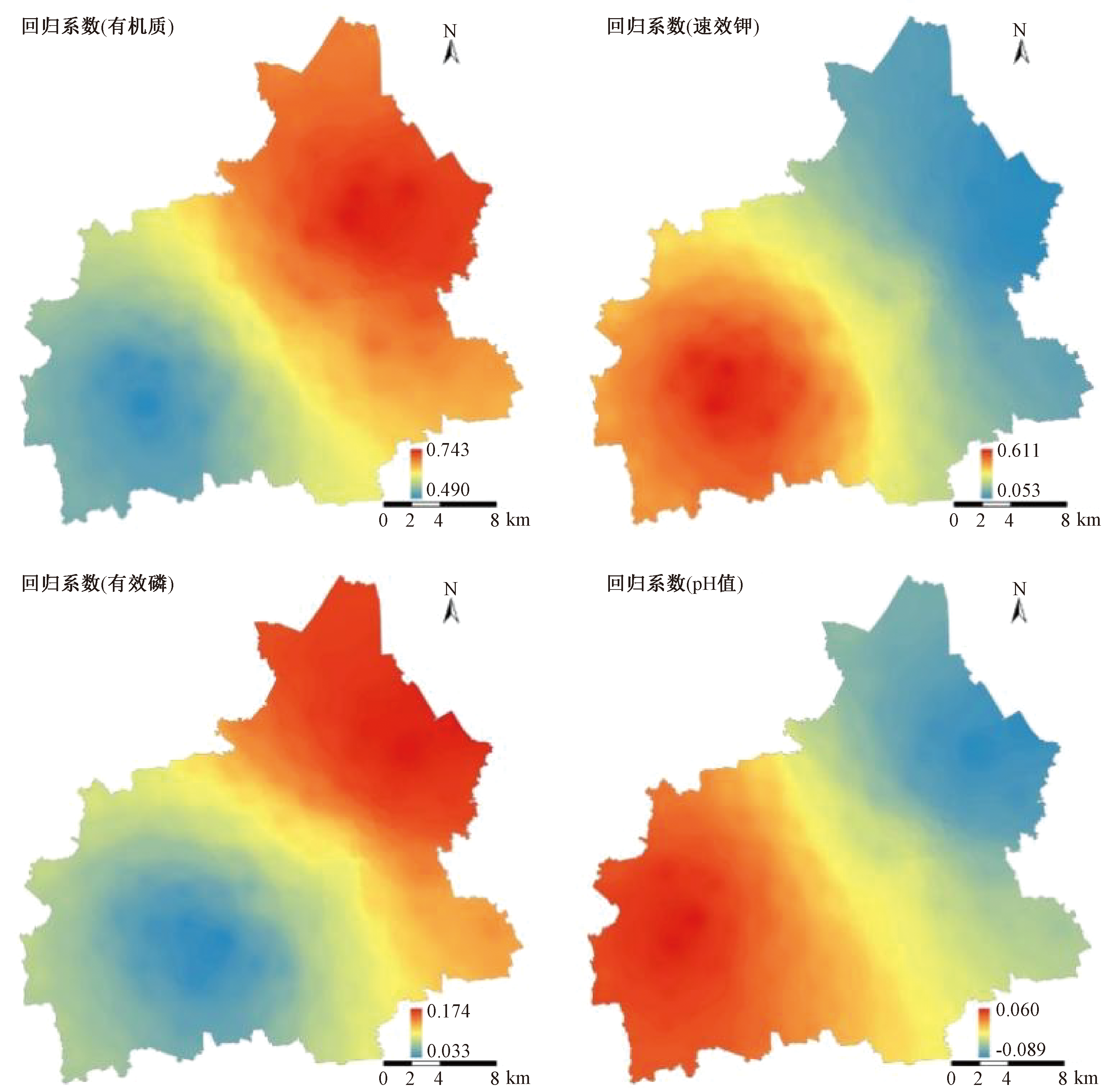
Fig.3 Spatial distribution of geographically weighted regression coefficients for each indicator
| [1] | QI X X, FU Y H, WANG R Y, et al. Improving the sustainability of agricultural land use: an integrated framework for the conflict between food security and environmental deterioration[J]. Applied Geography, 2018, 90: 214-223. |
| [2] | 史云扬, 艾东, 孙逸航, 等. 考虑“资源-资产-资本”属性的云南山区耕地质量评价与管理分区[J]. 农业工程学报, 2021, 37(20): 277-286, F0003. |
| SHI Y Y, AI D, SUN Y H, et al. Cultivated land quality evaluation and management zoning considering the attribute of“resource-asset-capital”in mountainous areas of Yunnan Province of China[J]. Transactions of the Chinese Society of Agricultural Engineering, 2021, 37(20): 277-286, F0003. | |
| [3] | YANG X J. China's rapid urbanization[J]. Science, 2013, 342(6156): 310. |
| [4] | GONG Y, NUNES L M, GREENFIELD B K, et al. Bioaccessibility-corrected risk assessment of urban dietary methylmercury exposure via fish and rice consumption in China[J]. Science of the Total Environment, 2018, 630: 222-230. |
| [5] | LI T T, LONG H L, ZHANG Y N, et al. Analysis of the spatial mismatch of grain production and farmland resources in China based on the potential crop rotation system[J]. Land Use Policy, 2017, 60: 26-36. |
| [6] | 沈仁芳, 王超, 孙波. “藏粮于地、藏粮于技”战略实施中的土壤科学与技术问题[J]. 中国科学院院刊, 2018, 33(2): 135-144. |
| SHEN R F, WANG C, SUN B. Soil related scientific and technological problems in implementing strategy of “storing grain in land and technology”[J]. Bulletin of Chinese Academy of Sciences, 2018, 33(2): 135-144. | |
| [7] | 许彩彩, 吕春娟, 陈卓, 等. 省域视角下耕地自然质量空间格局与影响因素[J]. 中国农业资源与区划, 2022, 43(3): 253-264. |
| XU C C, LYU C J, CHEN Z, et al. The spatial pattern and influencing factors of cultivated land natural quality from the perspective of province[J]. Chinese Journal of Agricultural Resources and Regional Planning, 2022, 43(3): 253-264. | |
| [8] | 王军, 李萍, 詹韵秋, 等. 中国耕地质量保护与提升问题研究[J]. 中国人口·资源与环境, 2019, 29(4): 87-93. |
| WANG J, LI P, ZHAN Y Q, et al. Study on the protection and improvement of cultivated land quality in China[J]. China Population, Resources and Environment, 2019, 29(4): 87-93. | |
| [9] | 赵瑞, 吴克宁, 张小丹, 等. 粮食主产区耕地健康产能评价: 以河南省温县为例[J]. 中国土地科学, 2019, 33(2): 67-75. |
| ZHAO R, WU K N, ZHANG X D, et al. Evaluation on farmland health productivity in main grain production areas: a case study in Wen County of Henan Province[J]. China Land Science, 2019, 33(2): 67-75. | |
| [10] | YUAN X F, SHAO Y J, WEI X D, et al. Study on the potential of cultivated land quality improvement based on a geological detector[J]. Geological Journal, 2018, 53(S1): 387-397. |
| [11] | 宋戈, 李丹, 梁海鸥, 等. 松嫩高平原黑土区耕地质量特征及其空间分异: 以黑龙江省巴彦县为例[J]. 经济地理, 2012, 32(7): 129-134. |
| SONG G, LI D, LIANG H O, et al. The characteristics of cultivated land quality and its spatial variation in black soil region of Songnen high plain: a case study of Bayan County in Heilongjiang Province[J]. Economic Geography, 2012, 32(7): 129-134. | |
| [12] | SHENG Y, LIU W Z, XU H L, et al. The spatial distribution characteristics of the cultivated land quality in the diluvial fan terrain of the arid region: a case study of Jimsar County, Xinjiang, China[J]. Land, 2021, 10(9): 896. |
| [13] | CHRISTAKOS G, SERRE M L. BME analysis of spatiotemporal particulate matter distributions in North Carolina[J]. Atmospheric Environment, 2000, 34(20): 3393-3406. |
| [14] | CHRISTAKOS G. Integrative problem-solving in a time of decadence[M]. Dordrecht: Springer Netherlands, c2010. |
| [15] | YANG Y, CHRISTAKOS G, GUO M W, et al. Space-time quantitative source apportionment of soil heavy metal concentration increments[J]. Environmental Pollution, 2017, 223: 560-566. |
| [16] | XIAO R, SU S L, WANG J Q, et al. Local spatial modeling of paddy soil landscape patterns in response to urbanization across the urban agglomeration around Hangzhou Bay, China[J]. Applied Geography, 2013, 39: 158-171. |
| [17] | 卢宾宾, 葛咏, 秦昆, 等. 地理加权回归分析技术综述[J]. 武汉大学学报(信息科学版), 2020, 45(9): 1356-1366. |
| LU B B, GE Y, QIN K, et al. A review on geographically weighted regression[J]. Geomatics and Information Science of Wuhan University, 2020, 45(9): 1356-1366. | |
| [18] | 中华人民共和国农业部. 土壤检测第1部分:土壤样品的采集、处理和贮存: NY/T 1121.1—2006[S]. 北京: 中国农业出版社, 2006. |
| [19] | 中华人民共和国农业部. 土壤检测第2部分: 土壤pH的测定: NY/T 1121.2—2006[S]. 北京: 中国农业出版社, 2006. |
| [20] | 中华人民共和国农业部. 土壤检测第4部分: 土壤容重的测定: NY/T 1121.4—2006[S]. 北京: 中国农业出版社, 2006. |
| [21] | 中华人民共和国农业部. 土壤检测第6部分: 土壤有机质的测定: NY/T 1121.6—2006[S]. 北京: 中国农业出版社, 2006. |
| [22] | 中华人民共和国农业部. 土壤检测第7部分: 土壤有效磷的测定: NY/T 1121.7—2014[S]. 北京: 中国农业出版社, 2015. |
| [23] | 中华人民共和国农业部. 土壤检测第24部分: 土壤全氮的测定自动定氮仪法: NY/T 1121.24—2012[S]. 北京: 中国标准出版社, 2012. |
| [24] | 中华人民共和国农业部. 土壤速效钾和缓效钾含量的测定: NY/T 889—2004[S]. 北京: 中国农业出版社, 2005. |
| [25] | 国家质量监督检验检疫总局中国国家标准化管理委员会. 耕地质量等级: GB/T 33469—2016[S]. 北京: 中国标准出版社, 2016. |
| [26] | 费徐峰, 任周桥, 楼昭涵, 等. 基于贝叶斯最大熵和辅助信息的土壤重金属含量空间预测[J]. 浙江大学学报(农业与生命科学版), 2019(4): 452-459. |
| FEI X F, REN Z Q, LOU Z H, et al. Prediction of soil heavy metal content under spatial scale based on Bayesian maximum entropy and auxiliary information[J]. Journal of Zhejiang University (Agriculture and Life Sciences), 2019(4): 452-459. | |
| [27] | CHRISTAKOS G, LI X Y. Bayesian maximum entropy analysis and mapping: a farewell to Kriging estimators[J]. Mathematical Geology, 1998, 30(4): 435-462. |
| [28] | REN Z Q, CHRISTAKOS G, LOU Z H, et al. Contamination assessment and source apportionment of metals and metalloids pollution in agricultural soil: a comparison of the APCA-MLR and APCA-GWR models[J]. Sustainability, 2022, 14(2): 783. |
| [29] | TU J, XIA Z G. Examining spatially varying relationships between land use and water quality using geographically weighted regression I: model design and evaluation[J]. Science of the Total Environment, 2008, 407(1): 358-378. |
| [30] | FEI X F, CHEN W Z, ZHANG S Q, et al. The spatio-temporal distribution and risk factors of thyroid cancer during rapid urbanization-a case study in China[J]. Science of the Total Environment, 2018, 630: 1436-1445. |
| [31] | FEI X F, CHRISTAKOS G, XIAO R, et al. Improved heavy metal mapping and pollution source apportionment in Shanghai City soils using auxiliary information[J]. Science of the Total Environment, 2019, 661: 168-177. |
| [32] | 陆幸鹦, 孙永泉, 陈吉, 等. 耕地质量提升和化肥减量增效技术模式[J]. 农业开发与装备, 2020(11): 104-105. |
| LU X Y, SUN Y Q, CHEN J, et al. Technical mode of improving cultivated land quality and increasing efficiency by reducing chemical fertilizer[J]. Agricultural Development & Equipments, 2020(11): 104-105. | |
| [33] | 顾万帆, 蒋玉根, 邵赛男, 等. 富阳市补充耕地的地力现状与提升建议[J]. 浙江农业科学, 2014, 55(4): 569-572. |
| GU W F, JIANG Y G, SHAO S N, et al. Present situation of soil fertility of supplementary cultivated land in Fuyang City and suggestions for improvement[J]. Journal of Zhejiang Agricultural Sciences, 2014, 55(4): 569-572. | |
| [34] | 冯固. 提高我国土壤-作物体系磷肥高效利用的途径[J]. 磷肥与复肥, 2021, 36(2): 4. |
| FENG G. Ways to improve the efficient utilization of phosphate fertilizer in soil-crop system in China[J]. Phosphate & Compound Fertilizer, 2021, 36(2): 4. |
| [1] | NI Jinyang, WANG Feng, YU Qiaogang, ZHOU Jun, SUN Wanchun, MA Shitai, LYU Yongjie, MA Junwei. Evolution characteristics and improvement technology research progress of soil acidification in southern China from 1950 to 2020 [J]. Journal of Zhejiang Agricultural Sciences, 2026, 67(1): 231-242. |
| [2] | LIAN Zhenghua, CHEN Yiding, KONG Haimin, CHEN Hongjin. Analysis of the current status and variation trend of the cultivated land quality in Zhejiang Province under long-term location monitoring [J]. Journal of Zhejiang Agricultural Sciences, 2025, 66(8): 2002-2007. |
| [3] | GUO Aihuan, LIAN Qingping, ZHANG Aiju, CHEN Wei, CHEN Huan, SHENG Pengcheng, YUAN Julin, CHEN Guangmei. Study on the variation characteristics and key driving factors of zooplankton community in Qianxiahu Reservoir [J]. Journal of Zhejiang Agricultural Sciences, 2025, 66(10): 2478-2486. |
| Viewed | ||||||
|
Full text |
|
|||||
|
Abstract |
|
|||||
