
Journal of Zhejiang Agricultural Sciences ›› 2026, Vol. 67 ›› Issue (4): 1035-1044.DOI: 10.16178/j.issn.0528-9017.20250354
Previous Articles Next Articles
ZHANG Kexin( )
)
Received:2025-05-16
Online:2026-04-11
Published:2026-04-17
CLC Number:
ZHANG Kexin. The impact of digital village development on rural residents′ operational income[J]. Journal of Zhejiang Agricultural Sciences, 2026, 67(4): 1035-1044.
Add to citation manager EndNote|Ris|BibTeX
URL: http://www.zjnykx.cn/EN/10.16178/j.issn.0528-9017.20250354
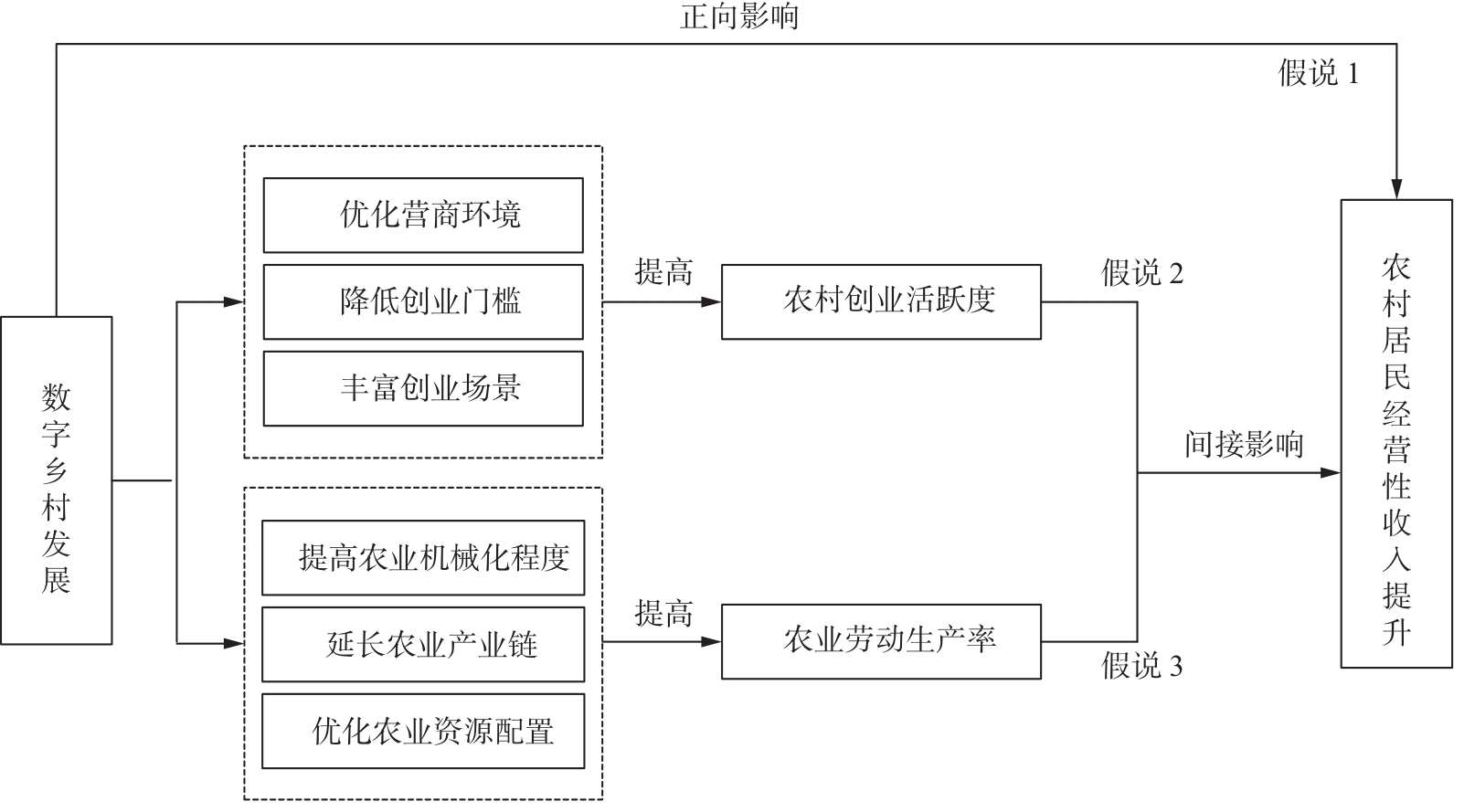
Fig.1 Mechanism of action
| 一级指标 | 二级指标 | 测度方法 | 属性 | 权重 |
|---|---|---|---|---|
| 数字基础设施 | 互联网普及率 | 开通互联网宽带业务的行政村比重 | 正 | 0.015 |
| 移动电话覆盖率 | 农村居民每百户拥有的移动电话数量 | 正 | 0.015 | |
| 光缆线路覆盖率 | 每平方千米光缆线路的长度 | 正 | 0.062 | |
| 农村投递线路率 | 投递段道上向农村用户投交的路线长度 | 正 | 0.047 | |
| 生产数字化 | 农业生产环境检测情况 | 环境与农业气象观测业务站点个数 | 正 | 0.028 |
| 农业生产电气化程度 | 农林牧渔业增加值/农村用电总量 | 正 | 0.055 | |
| 农业机械动力情况 | 人均农业机械总动力 | 正 | 0.075 | |
| 经营数字化 | 农村消费品零售情况 | 乡村消费品零售额/全社会消费品零售额 | 正 | 0.022 |
| 农村电商发展情况 | 淘宝村占行政村的比重 | 正 | 0.375 | |
| 电子商务销售额 | 基于网络订单而销售的商品和服务总额 | 正 | 0.148 | |
| 网络支付情况 | 北京大学数字普惠金融支付指数 | 正 | 0.018 | |
| 服务数字化 | 农村邮政通信服务情况 | 农村每周平均投递次数 | 正 | 0.030 |
| 农村交通通信情况 | 交通通信占农村居民消费支出的比重 | 正 | 0.031 | |
| 数字服务固定资产投资情况 | 交通运输、仓储和邮政业全社会固定资产投资 | 正 | 0.078 |
Table 1 Indicator system for digital village development level
| 一级指标 | 二级指标 | 测度方法 | 属性 | 权重 |
|---|---|---|---|---|
| 数字基础设施 | 互联网普及率 | 开通互联网宽带业务的行政村比重 | 正 | 0.015 |
| 移动电话覆盖率 | 农村居民每百户拥有的移动电话数量 | 正 | 0.015 | |
| 光缆线路覆盖率 | 每平方千米光缆线路的长度 | 正 | 0.062 | |
| 农村投递线路率 | 投递段道上向农村用户投交的路线长度 | 正 | 0.047 | |
| 生产数字化 | 农业生产环境检测情况 | 环境与农业气象观测业务站点个数 | 正 | 0.028 |
| 农业生产电气化程度 | 农林牧渔业增加值/农村用电总量 | 正 | 0.055 | |
| 农业机械动力情况 | 人均农业机械总动力 | 正 | 0.075 | |
| 经营数字化 | 农村消费品零售情况 | 乡村消费品零售额/全社会消费品零售额 | 正 | 0.022 |
| 农村电商发展情况 | 淘宝村占行政村的比重 | 正 | 0.375 | |
| 电子商务销售额 | 基于网络订单而销售的商品和服务总额 | 正 | 0.148 | |
| 网络支付情况 | 北京大学数字普惠金融支付指数 | 正 | 0.018 | |
| 服务数字化 | 农村邮政通信服务情况 | 农村每周平均投递次数 | 正 | 0.030 |
| 农村交通通信情况 | 交通通信占农村居民消费支出的比重 | 正 | 0.031 | |
| 数字服务固定资产投资情况 | 交通运输、仓储和邮政业全社会固定资产投资 | 正 | 0.078 |
| 变量 | 变量定义 | 样本数 | 均值 | 标准差 | 最小值 | 最大值 |
|---|---|---|---|---|---|---|
| 数字乡村发展水平 | 熵权法测量所得 | 300 | 0.17 | 0.09 | 0.06 | 0.64 |
| 农村居民经营性收入 | 农村居民人均经营性净收入取自然对数 | 300 | 8.48 | 0.40 | 7.16 | 9.31 |
| 财政支农水平 | 政府农林水支出占一般公共事务支出的比重 | 300 | 1.43 | 0.53 | 0.54 | 3.16 |
| 农村经济发展水平 | 农林牧渔业总产值与乡村人口数的比值 | 300 | 2.25 | 1.03 | 0.76 | 6.42 |
| 产业结构发展水平 | 第三产业增加值占地区生产总值的比重 | 300 | 0.50 | 0.09 | 0.32 | 0.84 |
| 城镇化水平 | 城镇人口数占人口总数的比例 | 300 | 0.61 | 0.11 | 0.38 | 0.90 |
| 人力资本水平 | 农村居民平均受教育年限 | 300 | 8.15 | 0.56 | 6.60 | 9.91 |
Table 2 Descriptive statistics
| 变量 | 变量定义 | 样本数 | 均值 | 标准差 | 最小值 | 最大值 |
|---|---|---|---|---|---|---|
| 数字乡村发展水平 | 熵权法测量所得 | 300 | 0.17 | 0.09 | 0.06 | 0.64 |
| 农村居民经营性收入 | 农村居民人均经营性净收入取自然对数 | 300 | 8.48 | 0.40 | 7.16 | 9.31 |
| 财政支农水平 | 政府农林水支出占一般公共事务支出的比重 | 300 | 1.43 | 0.53 | 0.54 | 3.16 |
| 农村经济发展水平 | 农林牧渔业总产值与乡村人口数的比值 | 300 | 2.25 | 1.03 | 0.76 | 6.42 |
| 产业结构发展水平 | 第三产业增加值占地区生产总值的比重 | 300 | 0.50 | 0.09 | 0.32 | 0.84 |
| 城镇化水平 | 城镇人口数占人口总数的比例 | 300 | 0.61 | 0.11 | 0.38 | 0.90 |
| 人力资本水平 | 农村居民平均受教育年限 | 300 | 8.15 | 0.56 | 6.60 | 9.91 |
| 变量 | (1) | (2) |
|---|---|---|
| 农村居民经营性收入 | 农村居民经营性收入 | |
| 数字乡村发展水平 | 2.094***(13.693) | 0.525***(5.568) |
| 财政支农水平 | — | 0.010(0.443) |
| 农村经济发展水平 | — | 0.079***(6.570) |
| 产业结构发展水平 | — | 0.229(1.386) |
| 城镇化水平 | — | 2.714***(9.381) |
| 人力资本水平 | — | 0.056**(2.575) |
| 常数项 | 8.120***(294.020) | 5.956***(31.662) |
| 省份固定效应 | 已控制 | 已控制 |
| 年份固定效应 | 已控制 | 已控制 |
| 样本量 | 300 | 300 |
| R2 | 0.411 | 0.879 |
Table 3 Results of regression
| 变量 | (1) | (2) |
|---|---|---|
| 农村居民经营性收入 | 农村居民经营性收入 | |
| 数字乡村发展水平 | 2.094***(13.693) | 0.525***(5.568) |
| 财政支农水平 | — | 0.010(0.443) |
| 农村经济发展水平 | — | 0.079***(6.570) |
| 产业结构发展水平 | — | 0.229(1.386) |
| 城镇化水平 | — | 2.714***(9.381) |
| 人力资本水平 | — | 0.056**(2.575) |
| 常数项 | 8.120***(294.020) | 5.956***(31.662) |
| 省份固定效应 | 已控制 | 已控制 |
| 年份固定效应 | 已控制 | 已控制 |
| 样本量 | 300 | 300 |
| R2 | 0.411 | 0.879 |
| 变量 | (1) | (2) | (3) |
|---|---|---|---|
| 替换被解释变量 | 缩尾处理 | 剔除直辖市 | |
数字乡村发 展水平 | 0.835*** (11.565) | 0.533*** (5.560) | 0.378*** (4.167) |
| 控制变量 | 已控制 | 已控制 | 已控制 |
| 常数项 | 6.221*** (43.202) | 5.965*** (32.317) | 6.351*** (38.098) |
| 省份固定效应 | 已控制 | 已控制 | 已控制 |
| 年份固定效应 | 已控制 | 已控制 | 已控制 |
| 样本量 | 300 | 300 | 260 |
| R2 | 0.956 | 0.884 | 0.917 |
Table 4 Results of robustness test
| 变量 | (1) | (2) | (3) |
|---|---|---|---|
| 替换被解释变量 | 缩尾处理 | 剔除直辖市 | |
数字乡村发 展水平 | 0.835*** (11.565) | 0.533*** (5.560) | 0.378*** (4.167) |
| 控制变量 | 已控制 | 已控制 | 已控制 |
| 常数项 | 6.221*** (43.202) | 5.965*** (32.317) | 6.351*** (38.098) |
| 省份固定效应 | 已控制 | 已控制 | 已控制 |
| 年份固定效应 | 已控制 | 已控制 | 已控制 |
| 样本量 | 300 | 300 | 260 |
| R2 | 0.956 | 0.884 | 0.917 |
| 变量 | (1) | (2) |
|---|---|---|
| 第一阶段 | 第二阶段 | |
| 数字乡村发展水平 | — | 1.463***(5.180) |
| 工具变量 | 0.002***(8.812) | — |
| 控制变量 | 已控制 | 已控制 |
| 常数项 | 0.278***(4.305) | 8.640***(33.001) |
| Kleibergen-Paap rk LM统计量 | — | 17.948[<0.000 1] |
| Kleibergen-Paap rk Wald F统计量 | — | 17.310{16.38} |
| 省份固定效应 | 已控制 | 已控制 |
| 年份固定效应 | 已控制 | 已控制 |
| 样本量 | 300 | 300 |
| R2 | 0.434 | 0.636 |
Table 5 Results of endogeneity test
| 变量 | (1) | (2) |
|---|---|---|
| 第一阶段 | 第二阶段 | |
| 数字乡村发展水平 | — | 1.463***(5.180) |
| 工具变量 | 0.002***(8.812) | — |
| 控制变量 | 已控制 | 已控制 |
| 常数项 | 0.278***(4.305) | 8.640***(33.001) |
| Kleibergen-Paap rk LM统计量 | — | 17.948[<0.000 1] |
| Kleibergen-Paap rk Wald F统计量 | — | 17.310{16.38} |
| 省份固定效应 | 已控制 | 已控制 |
| 年份固定效应 | 已控制 | 已控制 |
| 样本量 | 300 | 300 |
| R2 | 0.434 | 0.636 |
| 变量 | (1) | (2) |
|---|---|---|
| 农业劳动力规模大 | 农业劳动力规模小 | |
| 数字乡村发展水平 | 0.143(0.270) | 0.582***(5.041) |
| 控制变量 | 已控制 | 已控制 |
| 常数项 | 6.338***(27.521) | 5.464***(16.011) |
| 省份固定效应 | 已控制 | 已控制 |
| 年份固定效应 | 已控制 | 已控制 |
| 样本量 | 150 | 150 |
| R2 | 0.918 | 0.850 |
Table 6 Results of heterogeneity analysis
| 变量 | (1) | (2) |
|---|---|---|
| 农业劳动力规模大 | 农业劳动力规模小 | |
| 数字乡村发展水平 | 0.143(0.270) | 0.582***(5.041) |
| 控制变量 | 已控制 | 已控制 |
| 常数项 | 6.338***(27.521) | 5.464***(16.011) |
| 省份固定效应 | 已控制 | 已控制 |
| 年份固定效应 | 已控制 | 已控制 |
| 样本量 | 150 | 150 |
| R2 | 0.918 | 0.850 |
| 变量 | (1) | (2) |
|---|---|---|
| 农村创业活跃度 | 农业劳动生产率 | |
| 数字乡村发展水平 | 0.928***(5.870) | 9.623***(15.398) |
| 控制变量 | 已控制 | 已控制 |
| 常数项 | -0.713**(-2.261) | -0.523(-0.419) |
| 省份固定效应 | 已控制 | 已控制 |
| 年份固定效应 | 已控制 | 已控制 |
| 样本量 | 300 | 300 |
| R2 | 0.353 | 0.870 |
Table 7 Results of mechanism inspection
| 变量 | (1) | (2) |
|---|---|---|
| 农村创业活跃度 | 农业劳动生产率 | |
| 数字乡村发展水平 | 0.928***(5.870) | 9.623***(15.398) |
| 控制变量 | 已控制 | 已控制 |
| 常数项 | -0.713**(-2.261) | -0.523(-0.419) |
| 省份固定效应 | 已控制 | 已控制 |
| 年份固定效应 | 已控制 | 已控制 |
| 样本量 | 300 | 300 |
| R2 | 0.353 | 0.870 |
| [27] | ZHAO T, ZHANG Z, LIANG S K. Digital economy,entrepreneurial activity and high-quality development:empirical evidence from China city[J]. Management World,2020,36(10):65-75. |
| [28] | 田野,叶依婷,黄进,等. 数字经济驱动乡村产业振兴的内在机理及实证检验:基于城乡融合发展的中介效应[J]. 农业经济问题,2022(10):84-96. |
| TIAN Y, YE Y T, HUANG J,et al. The internal mechanism and empirical test of rural industrial revitalization driven by digital economy:based on the mediating effect of urban and rural integration development[J]. Issues in Agricultural Economy,2022(10):84-96. | |
| [29] | 唐菁,张娜,易露,等. 农业碳补偿率的空间格局及其驱动因素:来自长江经济带108个地级及以上城市的经验证据[J]. 中国人口·资源与环境,2024,34(9):76-92. |
| TANG J, ZHANG N, YI L,et al. Analysis of spatial patterns and driving factors of agricultural carbon offset rate:empirical evidence from 108 prefectural-level and above cities in the Yangtze River Economic Belt[J]. China Population,Resources and Environment,2024,34(9):76-92. | |
| [30] | 黄敦平,尹凯. 数字普惠金融发展能否提升农村创业活跃度[J]. 金融与经济,2023(8):43-53. |
| HUANG D P, YIN K. Can the development of digital inclusive finance increase the activity of rural entrepreneurship [J]. Finance and Economy,2023(8):43-53. | |
| [31] | 谢帮生,陈鎏鹏,周子渭. 数字乡村建设能助力乡村包容性绿色增长吗:基于双重机器学习的因果推断[J]. 中国人口·资源与环境,2024,34(12):167-179. |
| XIE B S, CHEN L P, ZHOU Z W. Can digital rural construction help promote inclusive and green growth in rural areas:causal inference based on dual machine learning[J]. China Population,Resources and Environment,2024,34(12):167-179. | |
| [32] | 杜建军,谢家平,刘博敏. 中国农业产业集聚与农业劳动生产率:基于275个城市数据的经验研究[J]. 财经研究,2020,46(6):49-63. |
| DU J J, XIE J P, LIU B M. Agricultural industry agglomeration and agricultural labor productivity in China:an empirical study based on data from 275 cities[J]. Journal of Finance and Economics,2020,46(6):49-63. | |
| [33] | 王森浩. 数字乡村建设与中国式农业产业链现代化:内在机制与经验证据[J]. 西北民族大学学报(哲学社会科学版),2024(4):176-188. |
| [1] | 张玉刚,王梦雪,曾加红. 数字乡村建设对农户收入提升影响的理论逻辑与数据检验[J]. 中央民族大学学报(哲学社会科学版),2024,51(6):135-147. |
| ZHANG Y G, WANG M X, ZENG J H. Theoretical logic and data test of the influence of digital rural construction on farmers' income improvement[J]. Journal of the Central University for Nationalities(Philosophy and Social Sciences Edition),2024,51(6):135-147. | |
| [33] | WANG S H. Digital rural construction and modernization of Chinese-style agricultural industry chain:internal mechanism and empirical evidence[J]. Journal of Northwest Minzu University(Philosophy and Social Sciences),2024(4):176-188. |
| [34] | 黄丽娟,谢国杰,郑雁玲,等. 乡村振兴背景下农村电商创业企业促进农村韧性发展的案例研究[J]. 江西财经大学学报,2023(5):78-90. |
| HUANG L J, XIE G J, ZHENG Y L,et al. A case study of rural E-commerce start-ups promoting rural resilient development in the context of rural revitalization[J]. Journal of Jiangxi University of Finance and Economics,2023(5):78-90. | |
| [35] | 曾永明,钟子康. 数字乡村建设如何促进后发地区农民收入增长:来自935个革命老区县的经验证据[J]. 云南农业大学学报,2025,19(2):29-36. |
| ZENG Y M, ZHONG Z K. How to promote the growth of farmers′ income in underdeveloped areas through digital rural construction:based on empirical evidence from 935 counties of revolutionary old areas[J]. Journal of Yunnan Agricultural University(Social Science),2025,19(2):29-36. | |
| [36] | 张岳,张博,周应恒. 数字乡村建设对农民收入的影响:基于收入水平与收入结构的视角[J]. 农林经济管理学报,2023,22(3):350-358. |
| ZHANG Y, ZHANG B, ZHOU Y H. Impact of digital village construction on farmers' income:based on the perspective of income level and income structure[J]. Journal of Agro-Forestry Economics and Management,2023,22(3):350-358. | |
| [37] | 周滔,黄冬月. 收入结构视角下农民收入增长动力的时空演化特征:以石漠化脱贫地区为例[J]. 人文地理,2024,39(1):48-58. |
| ZHOU T, HUANG D Y. The spatiotemporal evolutionary characteristics of farmers' income growth impetus from the perspective of income structure:a case study of rocky desertification poverty alleviation areas[J]. Human Geography,2024,39(1):48-58. | |
| [38] | 任慧,张东伟,芦霁嘉. 基于曲线回归模型的甘肃农业劳动生产率增收效应研究[J]. 寒旱农业科学,2024,3(12):1091-1096. |
| REN H, ZHANG D W, LU J J. Study on the income increasing effect of agricultural labor productivity in Gansu Province based on curve regression model[J]. Journal of Cold-Arid Agricultural Sciences,2024,3(12):1091-1096. | |
| [2] | 王善高. 数字乡村建设对农村居民共同富裕的影响研究[J]. 统计与决策,2025,41(2):48-53. |
| WANG S G. Research on the influence of digital village construction on the common prosperity of rural residents[J]. Statistics and Decision,2025,41(2):48-53. | |
| [3] | 万建香,汪亮. 数字乡村发展对农村家庭消费升级的影响[J]. 消费经济,2024,40(4):87-102. |
| WAN J X, WANG L. The impact of digital village development on rural households' consumption upgrading[J]. Consumer Economics,2024,40(4):87-102. | |
| [4] | 徐彩瑶,钱晨,孔凡斌. 数字乡村建设能否缩小城乡收入差距:基于农业科技进步中介和门槛效应的实证检验[J]. 农业技术经济,2024(12):4-24. |
| XU C Y, QIAN C, KONG F B. Can digital village construction narrow urban-rural income gap:an empirical test based on the mediating and threshold effect of agricultural scientific and technological progress[J]. Journal of Agrotechnical Economics,2024(12):4-24. | |
| [5] | 王敬. 数字乡村发展推动农业高质量发展研究[J]. 管理学刊,2024,37(5):146-158. |
| WANG J. Research on promoting high-quality agricultural development through digital rural development[J]. Journal of Management,2024,37(5):146-158. | |
| [6] | 杜建军,章友德,刘博敏,等. 数字乡村对农业绿色全要素生产率的影响及其作用机制[J]. 中国人口·资源与环境,2023,33(2):165-175. |
| DU J J, ZHANG Y D, LIU B M,et al. Impact of digital village construction on agricultural green total factor productivity and its mechanisms[J]. China Population Resources and Environment,2023,33(2):165-175. | |
| [7] | 黄敦平,尹凯. 数字经济与乡村产业振兴:内在机理与实证检验[J]. 中国石油大学学报(社会科学版),2024,40(5):89-96. |
| HUANG D P, YIN K. Digital economy and rural industrial revitalization:internal mechanism and empirical test[J]. Journal of China University of Petroleum(Edition of Social Science),2024,40(5):89-96. | |
| [8] | 斯丽娟,王超群. 数字基础设施建设对农村居民收入不平等的影响效应研究[J]. 求是学刊,2024,51(3):62-78. |
| SI L J, WANG C Q. Research on the impact of digital infrastructure construction on income inequality of rural residents[J]. Seeking Truth,2024,51(3):62-78. | |
| [9] | XU Y L, PENG Z, SUN Z J,et al. Does digital finance lessen credit rationing?:evidence from Chinese farmers[J]. Research in International Business and Finance,2022,62:101712. |
| [10] | 陈培彬,黄可权,朱朝枝. 数字乡村建设、农村创新创业活跃度与农业新质生产力[J]. 江汉大学学报(社会科学版),2024,41(6):76-89. |
| CHEN P B, HUANG K Q, ZHU C Z. Digital rural construction,vitality of rural innovation and entrepreneurship,and new quality productivity of agriculture[J]. Journal of Jianghan University(Social Sciences Edition),2024,41(6):76-89. | |
| [11] | 陈熹,徐蕾. 数字金融、创新创业与城乡居民收入增长[J]. 农林经济管理学报,2022,21(5):537-546. |
| CHEN X, XU L. Digital finance,innovation and entrepreneurship and income growth of urban and rural residents[J]. Journal of Agro-Forestry Economics and Management,2022,21(5):537-546. | |
| [12] | 王轶,武青远. 营商环境能提升返乡创业企业发展质量吗[J]. 湘潭大学学报(哲学社会科学版),2024,48(2):54-61. |
| WANG Y, WU Q Y. Can business environment enhance the development quality of enterprises started up by returnees to hometown [J]. Journal of Xiangtan University(Philosophy and Social Sciences),2024,48(2):54-61. | |
| [13] | 王善高,余义,华树春. 营商环境对农村居民收入的影响效应及其机制研究[J]. 兰州学刊,2024(12):130-147. |
| WANG S G, YU Y, HUA S C. Study on the impact of business environment on farmer' s income and its mechanism[J]. Lanzhou Academic Journal,2024(12):130-147. | |
| [14] | 齐文浩,李明杰,李景波. 数字乡村赋能与农民收入增长:作用机理与实证检验:基于农民创业活跃度的调节效应研究[J]. 东南大学学报(哲学社会科学版),2021,23(2):116-125. |
| QI W H, LI M J, LI J B. The mechanism and empirical examination of digital empowerment and rural income growth:a study on the moderating effect based on rural residents' entrepreneurial activity[J]. Journal of Southeast University(Philosophy and Social Science),2021,23(2):116-125. | |
| [15] | 贺志骏. 疫情冲击下产业链延伸模式对于农民增收韧性的影响研究[J]. 林业经济,2024,46(1):5-31. |
| HE Z J. Research on the impact of industrial chain extension mode on farmers' income increase resilience under COVID-19 epidemic shock[J]. Forestry Economics,2024,46(1):5-31. | |
| [16] | 张勋,万广华,吴海涛. 缩小数字鸿沟:中国特色数字金融发展[J]. 中国社会科学,2021(8):35-51. |
| ZHANG X, WAN G H, WU H T. Narrowing the digital divide:the development of digital finance with Chinese characteristics[J]. Social Sciences in China,2021(8):35-51. | |
| [17] | 杜蓉,柳思维,冯佑帅. 数字乡村发展对农村居民消费的影响机制实证研究[J]. 经济地理,2024,44(4):190-200. |
| DU R, LIU S W, FENG Y S. Influence mechanism of digital village development on rural residents' consumption[J]. Economic Geography,2024,44(4):190-200. | |
| [18] | 周鹏飞,李美宏. 数字乡村建设赋能农业经济韧性:影响机理与实证考察[J]. 调研世界,2023(9):15-24. |
| ZHOU P F, LI M H. Digital rural construction enabling agricultural economic resilience:impact mechanism and empirical study[J]. The World of Survey and Research,2023(9):15-24. | |
| [19] | 朱红根,陈晖. 中国数字乡村发展的水平测度、时空演变及推进路径[J]. 农业经济问题,2023(3):21-33. |
| ZHU H G, CHEN H. Measurement,spatial-temporal evolution and promotion path of digital village development in China[J]. Issues in Agricultural Economy,2023(3):21-33. | |
| [20] | 李占风,曾炬. 新质生产力对乡村振兴的影响效应检验[J]. 统计与决策,2024,40(21):23-28. |
| LI Z F, ZENG J. Test on the effect of new quality productivity on rural revitalization[J]. Statistics and Decision,2024,40(21):23-28. | |
| [21] | 王锋,李皓浩. 数字乡村发展对农民增收致富的影响机制研究[J]. 上海经济研究,2024(11):18-30. |
| WANG F, LI H H. Study on the impact mechanism of digital village development on farmers' income growth[J]. Shanghai Journal of Economics,2024(11):18-30. | |
| [22] | 李媛,阮连杰. 中国数字乡村发展的测度、动态演进及驱动因素[J]. 统计与信息论坛,2025,40(1):106-118. |
| LI Y, RUAN L J. Measurement,dynamic evolution,and driving factors of digital rural development in China[J]. Journal of Statistics and Information,2025,40(1):106-118. | |
| [23] | 谭启鸿. 农旅融合发展与农民农村共同富裕:基于全国休闲农业与乡村旅游示范县政策的经验证据[J]. 商业经济研究,2025(23):91-96. |
| TAN Q H. Integrated development of agriculture and tourism and common prosperity of farmers and rural areas:empirical evidence based on policies of national demonstration counties for leisure agriculture and rural tourism[J]. Journal of Commercial Economics,2025(23):91-96. | |
| [24] | 江艇. 因果推断经验研究中的中介效应与调节效应[J]. 中国工业经济,2022(5):100-120. |
| JIANG T. Mediating effects and moderating effects in causal inference[J]. China Industrial Economics,2022(5):100-120. | |
| [25] | 陈燕,林乐芬. 政策性农业保险的福利效应:基于农民视角的分析[J]. 中国农村观察,2023(1):116-135. |
| CHEN Y, LIN L F. The welfare effects of policy-based agricultural insurance:an analysis from the perspective of farmers[J]. China Rural Survey,2023(1):116-135. | |
| [26] | 陈培彬,黄可权,朱朝枝. 农业新质生产力对农业碳排放强度的影响研究[J]. 管理现代化,2025,45(1):21-31. |
| CHEN P B, HUANG K Q, ZHU C Z. Research on the impact of agricultural new quality productivity on agricultural carbonemission intensity[J]. Modernization of Management,2025,45(1):21-31. | |
| [27] | 赵涛,张智,梁上坤. 数字经济、创业活跃度与高质量发展:来自中国城市的经验证据[J]. 管理世界,2020,36(10):65-75. |
| [1] | ZHANG Liaoyuan, KONG Lingcheng. Digital rural construction, spatial spillover and common prosperity of farmers and rural areas—Based on the panel data of Yangtze river economic belt [J]. Journal of Zhejiang Agricultural Sciences, 2025, 66(9): 2304-2312. |
| [2] | ZHOU Shuning, PAN Weiguang. Effect of digital village development on unleashing the consumption potential of rural residents [J]. Journal of Zhejiang Agricultural Sciences, 2025, 66(11): 2796-2801. |
| [3] | QU Yi. Digital villages, agricultural industry agglomeration and common prosperity [J]. Journal of Zhejiang Agricultural Sciences, 2024, 65(5): 1249-1256. |
| Viewed | ||||||
|
Full text |
|
|||||
|
Abstract |
|
|||||
