Journal of Zhejiang Agricultural Sciences ›› 2026, Vol. 67 ›› Issue (9): 2339-2344.DOI: 10.16178/j.issn.0528-9017.20260489

Previous Articles    

Structural characteristics of the spatial correlation network of agripreneurs in Zhejiang Province

LI Xiaochu1(), XIAO Chenwen2(), LI Muwen3, XIAO Wenxuan4   

  1. 1.Agricultural Entrepreneurs Development Association of Zhejiang Province,Hangzhou 310020,Zhejiang
    2.Institute of Animal Husbandry and Veterinary Science,Zhejiang Academy of Agricultural Sciences,Hangzhou 310021,Zhejiang
    3.Xiaoshan High School,Zhejiang Province,Hangzhou 311200,Zhejiang
    4.Hangzhou Linping No. 2 High School,Hangzhou 311199,Zhejiang
  • Received:2026-06-23 Online:2026-09-11 Published:2026-09-24
  • Contact: XIAO Chenwen

Abstract:

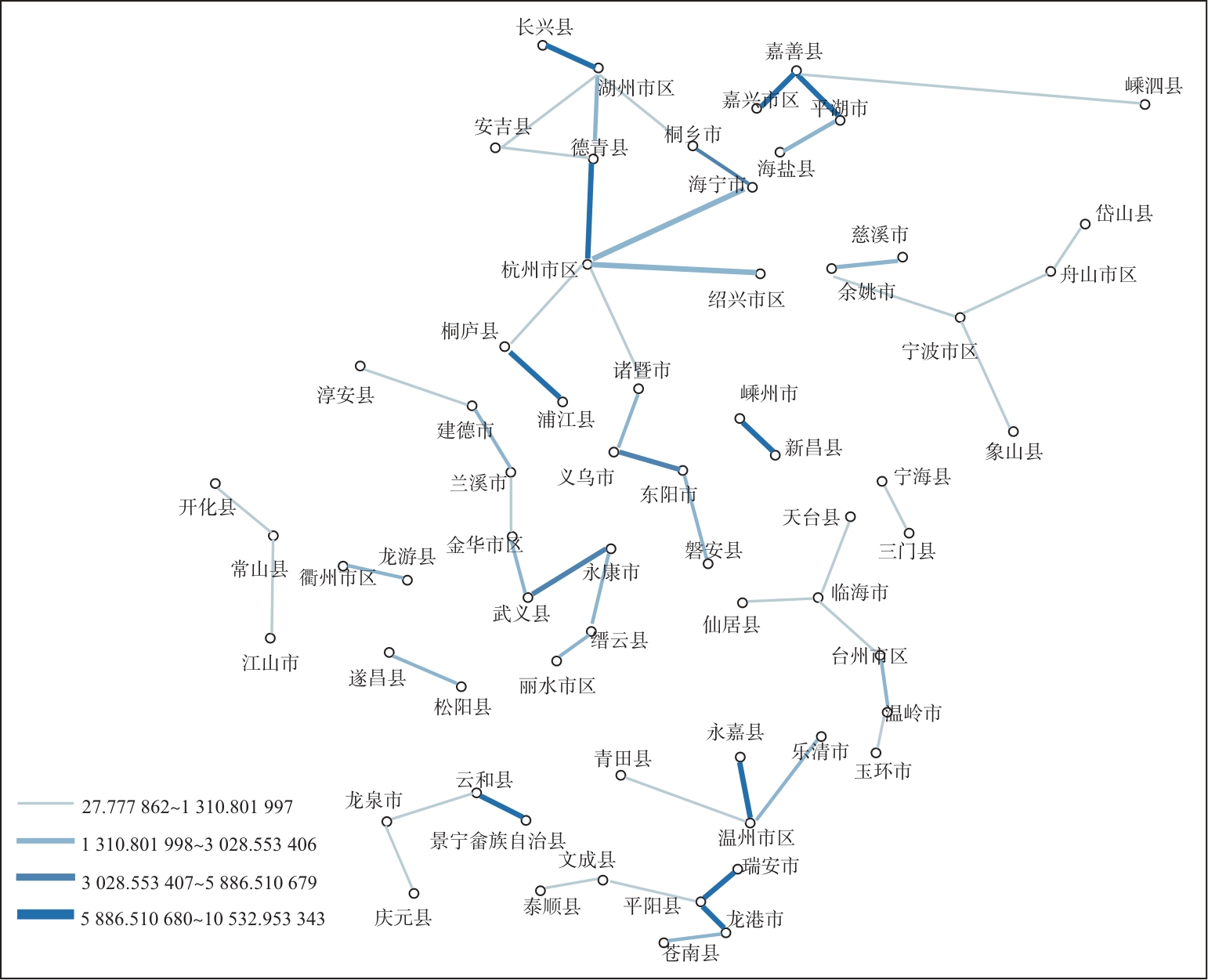
This study focuses on agripreneurs in 64 counties(cities and districts)of Zhejiang Province as the research subjects. By constructing a comprehensive livelihood resilience evaluation index system(covering three dimensions:buffering capacity,self-organizing capacity,and learning capacity),the entropy method was employed to determine indicator weights. An improved gravity model was then used to establish the spatial network structure of agripreneurs. Using UCINET 6.0 and ArcGIS software,network density,centrality,and cohesive subgroups were analyzed. The findings reveal that the overall network connectivity density of agripreneurs in Zhejiang is relatively low(network density of 0.156 8),yet significant spatial clustering characteristics exist. Core regions such as Hangzhou and Huzhou emerge as network hubs due to resource aggregation and policy advantages,while geographical proximity and industrial complementarity serve as primary drivers of strong spatial associations. The research provides theoretical foundations and practical references for optimizing regional collaborative development policies for agripreneurs.

Key words: agripreneurs, livelihood resilience, spatial correlation networks, gravity model, spatial structure

CLC Number: