Journal of Zhejiang Agricultural Sciences ›› 2026, Vol. 67 ›› Issue (10): 2576-2584.DOI: 10.16178/j.issn.0528-9017.20250621

Previous Articles     Next Articles

Measurement and spatial pattern analysis of county economic development level in Liaoning Province

LIU Zheng1(), LIU Xinyu2(), WANG Jinsong3, LI Yuanxin1, ZHAO Yuefeng1, HAO Xuran1   

  1. 1.Liaoning Academy of Agricultural Sciences,Shenyang 110161,Liaoning
    2.Organic Recycling Research Institute(Suzhou),China Agricultural University,Suzhou 215100,Jiangsu
    3.The College of Economics and Management,Shenyang Agricultural University,Shenyang 110866,Liaoning
  • Received:2025-08-28 Online:2026-10-11 Published:2026-10-19
  • Contact: LIU Xinyu

Abstract:

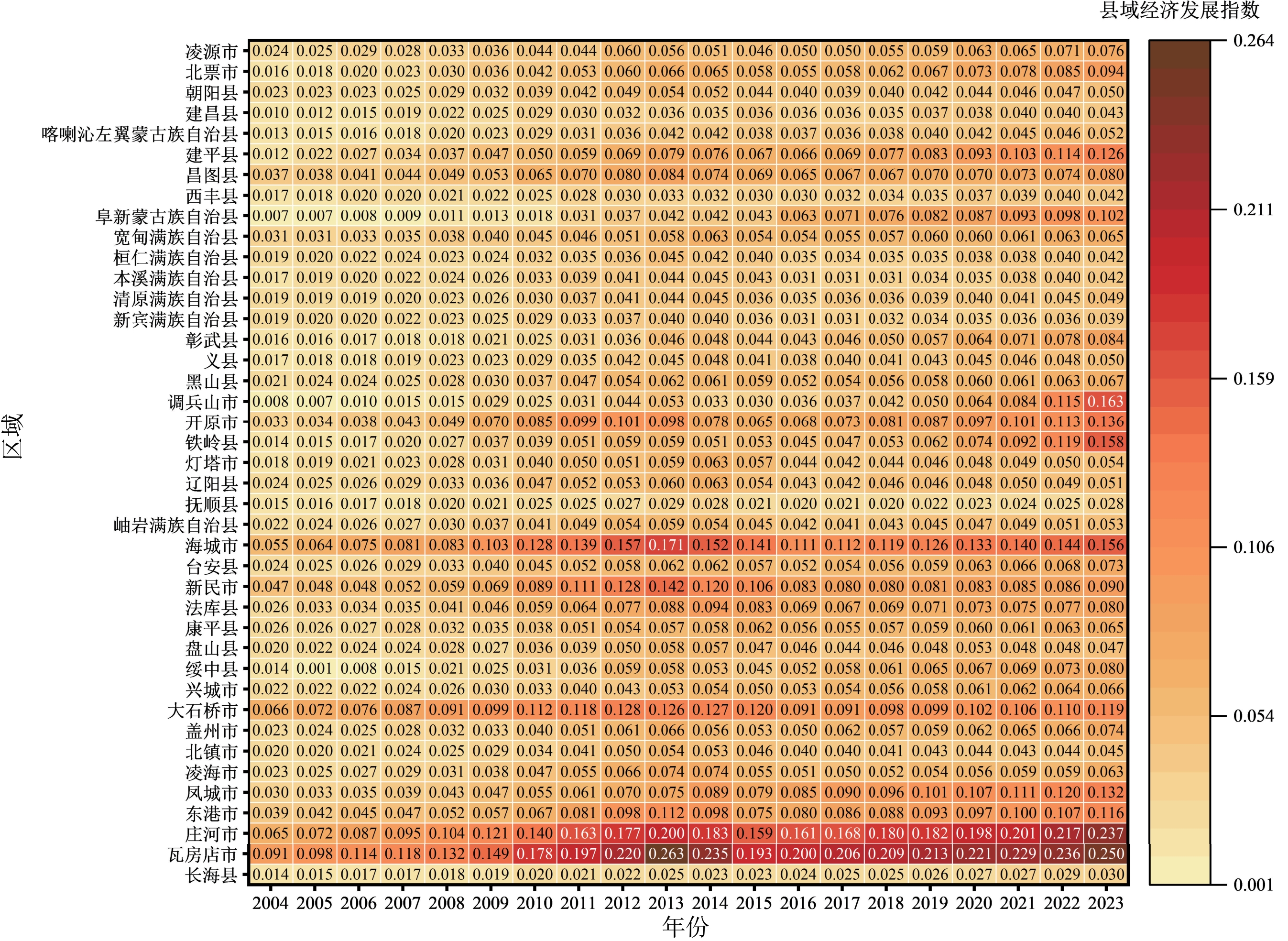
To comprehensively reveal the spatiotemporal evolution of county economic development in Liaoning Province,this study constructed an evaluation index system based on data from 41 county-level administration regions from 2004 to 2023. The entropy method was adopted to calculate the comprehensive development index,and the Dagum Gini coefficient decomposition and spatial autocorrelation models were further applied to systematically analyze the temporal evolution,regional disparities,and spatial patterns. The results showed that the overall county economic development level in Liaoning Province exhibited a steady upward trend. In 2004,the county economic development index of most county-level administration regions ranged from 0.010 to 0.040,while by 2023 some county-level administration regions exceeded 0.200,with the highest reaching 0.250,indicating enhanced overall quality and vitality. Regarding regional disparities,the Dagum Gini coefficient decreased from 0.342 in 2004 to 0.266 in 2016,indicating convergence,but then gradually rose to 0.303 in 2023,displaying a dynamic evolution of first narrowing and then widening. Inter-regional disparity remained the primary source of overall inequality throughout the study period. Among the three regions,the coastal area exhibited the largest intra-regional disparity,the central urban agglomeration area was relatively balanced,and the northwest ecologically fragile area showed fluctuating disparity. In terms of spatial patterns,the global Moran's I index fluctuated between 0.026 and 0.069,indicating weak but consistently positive overall spatial autocorrelation. Local spatial autocorrelation analysis revealed that counties such as Xinmin were persistently in high-high clustering areas,while Zhangwu remained in low-high heterogeneous areas,reflecting a notable path-locking effect. Overall,the county economic development in Liaoning Province is characterized by simultaneous overall improvement and regional divergence. Future efforts should further leverage the driving role of advantaged counties in coastal and central areas,strengthen spatial cooperation and balanced public services among counties,and promote leapfrog development in the northwest ecologically fragile area,so as to achieve coordinated and sustainable county economic development.

Key words: Liaoning Province, county economic development, entropy method, Dagum Gini coefficient, spatial autocorrelation

CLC Number: