
Journal of Zhejiang Agricultural Sciences ›› 2026, Vol. 67 ›› Issue (1): 222-230.DOI: 10.16178/j.issn.0528-9017.20250491
Previous Articles Next Articles
FU Lijun1( ), KE Siqi1, HAN Xiaoqing1, ZHANG Shangqing1, YAN Hongbo1, DUAN Huimin1, ZHOU Yu2,*()
Received:2025-07-08
Online:2026-01-11
Published:2026-01-19
Contact:
ZHOU Yu
CLC Number:
FU Lijun, KE Siqi, HAN Xiaoqing, ZHANG Shangqing, YAN Hongbo, DUAN Huimin, ZHOU Yu. Effects of Bacillus subtilis on yield, disease resistance, and soil improvement in continuous ginger cropping[J]. Journal of Zhejiang Agricultural Sciences, 2026, 67(1): 222-230.
Add to citation manager EndNote|Ris|BibTeX
URL: http://www.zjnykx.cn/EN/10.16178/j.issn.0528-9017.20250491
| 处理组 | 病株率/% | 产量/(kg·hm-2) | ||
|---|---|---|---|---|
| 茎基腐病 | 根腐病 | 合计 | ||
| 对照(CK) | 4.52±1.16 a | 2.47±0.49 a | 6.99 | 75 236.91±2 785.17 b |
| 微生物菌剂处理(TM) | 1.83±0.67 b | 0.86±0.37 b | 2.69 | 85 649.69±2 136.40 a |
Table 1 Disease rate and yield of ginger under different treatment
| 处理组 | 病株率/% | 产量/(kg·hm-2) | ||
|---|---|---|---|---|
| 茎基腐病 | 根腐病 | 合计 | ||
| 对照(CK) | 4.52±1.16 a | 2.47±0.49 a | 6.99 | 75 236.91±2 785.17 b |
| 微生物菌剂处理(TM) | 1.83±0.67 b | 0.86±0.37 b | 2.69 | 85 649.69±2 136.40 a |
| 处理 | pH值 | 有机质含量/(g·kg-1) | 全氮含量/(g·kg-1) | 有效磷含量/(mg·kg-1) | 速效钾含量/(mg·kg-1) |
|---|---|---|---|---|---|
| 对照(CK) | 7.97±0.05 a | 27.33±0.31 a | 1.94±0.04 a | 53.10±3.18 a | 296.27±9.65 b |
| 微生物菌剂处理(TM) | 7.80±0.10 a | 28.63±0.55 a | 1.94±0.07 a | 56.23±4.27 a | 354.33±18.75 a |
Table 2 Physical and chemical properties of ginger soil under different treatments
| 处理 | pH值 | 有机质含量/(g·kg-1) | 全氮含量/(g·kg-1) | 有效磷含量/(mg·kg-1) | 速效钾含量/(mg·kg-1) |
|---|---|---|---|---|---|
| 对照(CK) | 7.97±0.05 a | 27.33±0.31 a | 1.94±0.04 a | 53.10±3.18 a | 296.27±9.65 b |
| 微生物菌剂处理(TM) | 7.80±0.10 a | 28.63±0.55 a | 1.94±0.07 a | 56.23±4.27 a | 354.33±18.75 a |
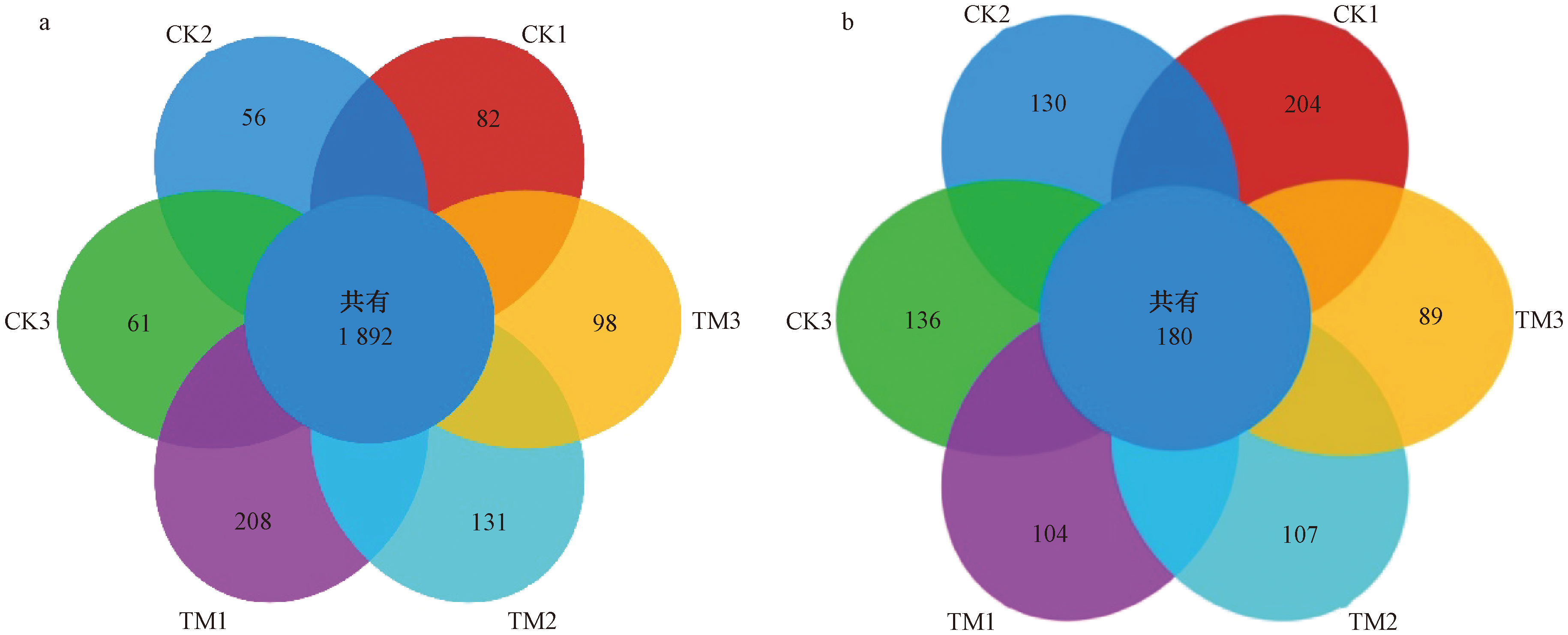
Fig.1 Venn diagram of bacteria and fungi OTU in the rhizosphere soil of ginger under different treatments
| 样本编号 | 细菌α-多样性指数 | 真菌α-多样性指数 | ||||||
|---|---|---|---|---|---|---|---|---|
| Chao1指数 | Shannon指数 | Shannoneven指数 | Coverage指数 | Chao1指数 | Shannon指数 | Shannoneven指数 | Coverage指数 | |
| CK1 | 3 258.35 ab | 6.25 bc | 0.78 c | 0.99 | 928.49 a | 4.61 ab | 0.67 bc | 1.00 |
| CK2 | 3 106.72 bc | 6.38 b | 0.80 bc | 0.98 | 857.24 ab | 4.50 b | 0.62 d | 1.00 |
| CK3 | 2 852.14 d | 5.94 c | 0.73 d | 1.00 | 875.39 ab | 4.58 ab | 0.66 c | 1.00 |
| TM1 | 3 327.48 a | 6.89 a | 0.86 a | 0.98 | 821.20 b | 4.78 a | 0.74 a | 1.00 |
| TM2 | 3 189.45 ab | 6.77 a | 0.84 a | 0.99 | 722.17 c | 4.43 b | 0.69 b | 1.00 |
| TM3 | 3 015.10 cd | 6.59 ab | 0.83 ab | 0.99 | 620.47 d | 4.51 b | 0.70 b | 1.00 |
Table 3 Alpha diversity of bacterial and fungal communities in the rhizosphere soil of ginger under different treatments
| 样本编号 | 细菌α-多样性指数 | 真菌α-多样性指数 | ||||||
|---|---|---|---|---|---|---|---|---|
| Chao1指数 | Shannon指数 | Shannoneven指数 | Coverage指数 | Chao1指数 | Shannon指数 | Shannoneven指数 | Coverage指数 | |
| CK1 | 3 258.35 ab | 6.25 bc | 0.78 c | 0.99 | 928.49 a | 4.61 ab | 0.67 bc | 1.00 |
| CK2 | 3 106.72 bc | 6.38 b | 0.80 bc | 0.98 | 857.24 ab | 4.50 b | 0.62 d | 1.00 |
| CK3 | 2 852.14 d | 5.94 c | 0.73 d | 1.00 | 875.39 ab | 4.58 ab | 0.66 c | 1.00 |
| TM1 | 3 327.48 a | 6.89 a | 0.86 a | 0.98 | 821.20 b | 4.78 a | 0.74 a | 1.00 |
| TM2 | 3 189.45 ab | 6.77 a | 0.84 a | 0.99 | 722.17 c | 4.43 b | 0.69 b | 1.00 |
| TM3 | 3 015.10 cd | 6.59 ab | 0.83 ab | 0.99 | 620.47 d | 4.51 b | 0.70 b | 1.00 |
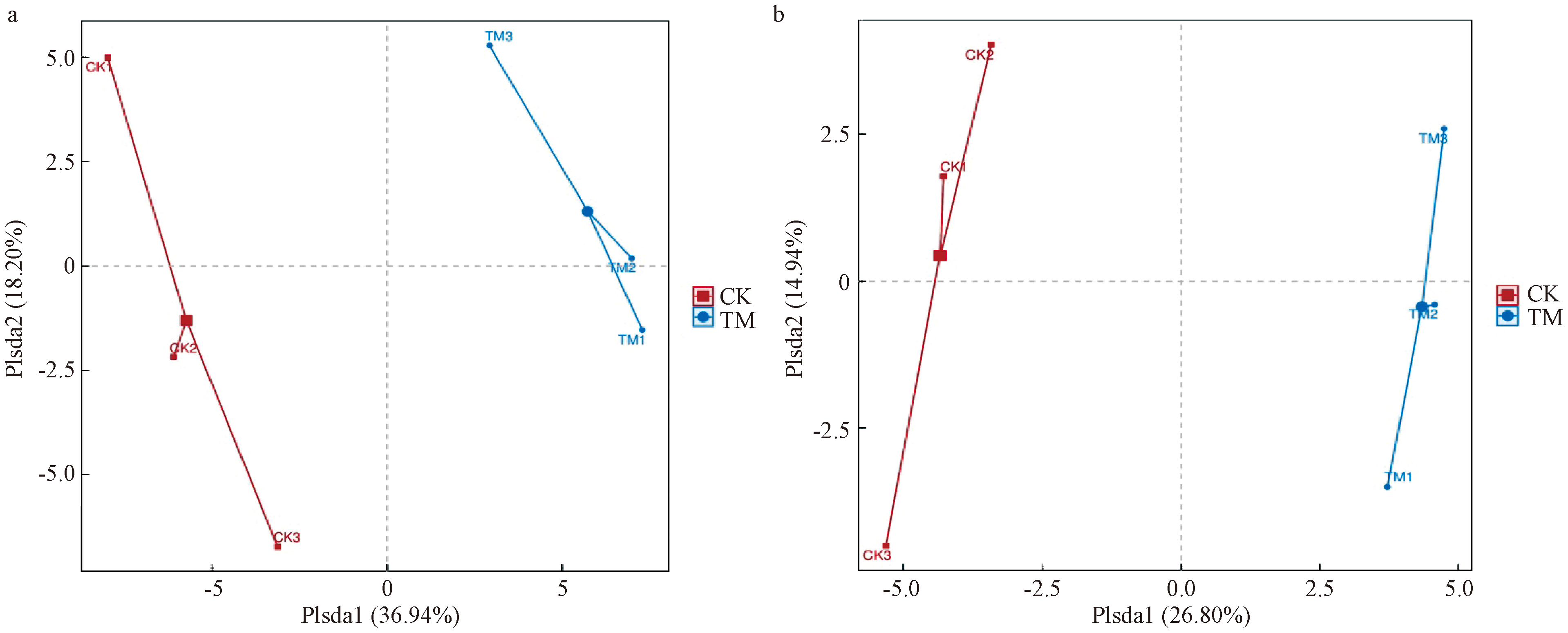
Fig.2 PLS-DA plot of bacterial and fungal communities in the rhizosphere soil of ginger under different treatments (genus level)
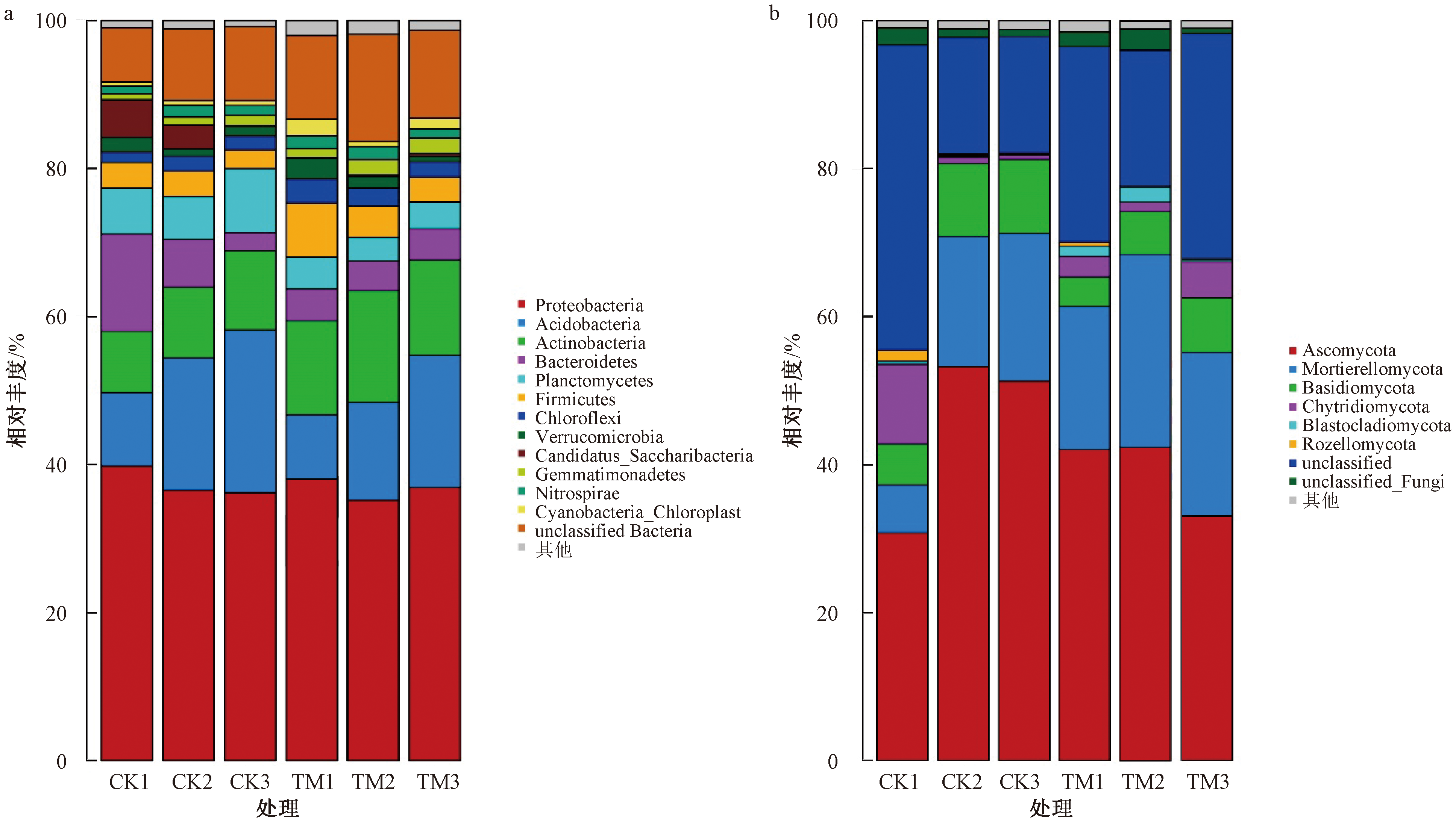
Fig.3 Relative abundance of bacteria and fungi in rhizosphere soil of ginger at the phylum level under different treatments
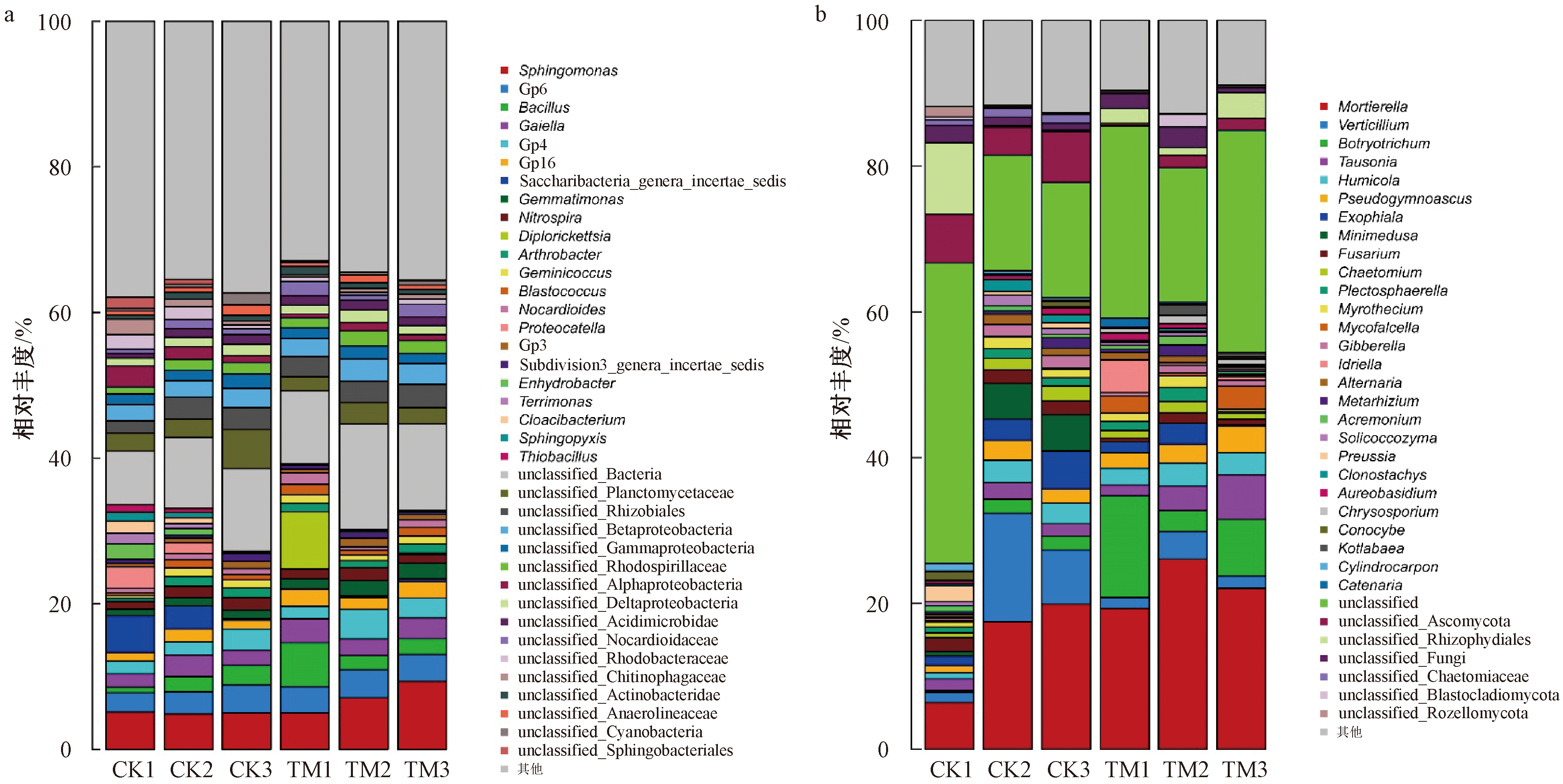
Fig.4 Relative abundance of bacteria and fungi in rhizosphere soil of ginger at the genus level under different treatments
| [1] | 石娜娜, 袁成磊. 潍坊生姜茎基腐病拮抗菌株筛选及鉴定[J]. 潍坊工程职业学院学报, 2022, 35(5): 84-89. |
| SHI N N, YUAN C L. Screening and identification of ginger stem based rot antagonistic strains in Weifang[J]. Journal of Weifang Engineering Vocational College, 2022, 35(5): 84-89. | |
| [2] | 张晓明, 辛增英, 辛燕. 微生物菌肥在连作生姜上应用效果初探[J]. 基层农技推广, 2022(4): 40-42. |
| ZHANG X M, XIN Z Y, XIN Y. Preliminary study on the application effect of microbial bacterial fertilizer on continuous cropping ginger[J]. Primary Agricultural Technology Extension, 2022(4): 40-42. | |
| [3] | 陈政. 连作生姜根际土壤微生物群落结构分析[D]. 泰安: 山东农业大学, 2013. |
| CHEN Z. Analysis of continuous cropping on rhizosphere microbial community structure in ginger field[D]. Tai’an: Shandong Agricultural University, 2013. | |
| [4] | 孙世君, 刘琦, 叶英杰, 等. 腐植酸对不同连作年限温室黄瓜土壤养分和微生物群落结构的影响[J]. 河南农业科学, 2022, 51(2): 65-74. |
| SUN S J, LIU Q, YE Y J, et al. Effects of humic acid on soil nutrients and microbial community structure of cucumber with different continuous cropping years in greenhouse[J]. Journal of Henan Agricultural Sciences, 2022, 51(2): 65-74. | |
| [5] | ZHANG J, WANG P C, TIAN H M, et al. Pyrosequencing-based assessment of soil microbial community structure and analysis of soil properties with vegetable planted at different years under greenhouse conditions[J]. Soil and Tillage Research, 2019, 187: 1-10. |
| [6] | 张美存, 程田, 多立安, 等. 微生物菌剂对草坪植物高羊茅生长与土壤酶活性的影响[J]. 生态学报, 2017, 37(14): 4763-4769. |
| ZHANG M C, CHENG T, DUO L A, et al. Effects of microbial agents on the growth of turfgrass Festuca arundinacea and soil enzyme activity[J]. Acta Ecologica Sinica, 2017, 37(14): 4763-4769. | |
| [7] | 彭海龙, 徐天宇, 钟秉峰, 等. 生防菌剂链霉菌JD211对水稻土壤微生物群落结构及碳代谢的影响[J]. 江西农业大学学报, 2023, 45(2): 384-394. |
| PENG H L, XU T Y, ZHONG B F, et al. Effect of biocide Streptomyces JD211 on soil microbial community structure and carbon metabolism in rice[J]. Acta Agriculturae Universitatis Jiangxiensis, 2023, 45(2): 384-394. | |
| [8] | BHATTACHARYYA P N, JHA D K. Plant growth-promoting rhizobacteria (PGPR): emergence in agriculture[J]. World Journal of Microbiology and Biotechnology, 2012, 28(4): 1327-1350. |
| [9] | 李庆荣, 邢东旭, 肖阳, 等. 枯草芽孢杆菌生防菌株SEM-9根际定植及对根际土壤微生物多样性的影响[J]. 华南农业大学学报, 2022, 43(4): 82-88. |
| LI Q R, XING D X, XIAO Y, et al. Rhizosphere colonization of Bacillus subtilis biocontrol strain SEM-9 and the effect on microbial diversity in rhizosphere soil[J]. Journal of South China Agricultural University, 2022, 43(4): 82-88. | |
| [10] | HINAREJOS E, CASTELLANO M, RODRIGO I, et al. Bacillus subtilis IAB/BS03 as a potential biological control agent[J]. European Journal of Plant Pathology, 2016, 146(3): 597-608. |
| [11] | 杨晓帆, 梁家慧, 于文英, 等. 促生荧光假单胞菌对桃树根区土壤环境和植株生长的影响[J]. 植物营养与肥料学报, 2022, 28(8): 1494-1508. |
| YANG X F, LIANG J H, YU W Y, et al. Effect of Pseudomonas fluorescens on rhizospheric soil quality and growth of peach (Prunus persica L. Batsch)[J]. Journal of Plant Nutrition and Fertilizers, 2022, 28(8): 1494-1508. | |
| [12] | 冀玉良, 赵志新, 高宝云. 枯草芽孢杆菌PS-8对桔梗连作障碍土壤的修复及其促生作用[J]. 商洛学院学报, 2022, 36(6): 15-25, 72. |
| JI Y L, ZHAO Z X, GAO B Y. The improvement of Bacillus subtilis PS-8 on continuous cropping obstacle soil and its growth-promoting effect on Platycodon grandiflorum[J]. Journal of Shangluo University, 2022, 36(6): 15-25, 72. | |
| [13] | 马二磊, 黄芸萍, 臧全宇, 等. 4种微生物菌剂对多年连作甜瓜土壤真菌群落的影响[J]. 中国瓜菜, 2021, 34(4): 15-20. |
| MA E L, HUANG Y P, ZANG Q Y, et al. Effects of four microbial agents on soil fungal community in continuous cropping melon based on diversity sequencing[J]. China Cucurbits and Vegetables, 2021, 34(4): 15-20. | |
| [14] | 沙月霞, 黄泽阳, 魏照清. 生物菌剂撒施对宁夏石嘴山盐碱地微生物群落结构的影响[J]. 中国农学通报, 2022, 38(34): 82-90. |
| SHA Y X, HUANG Z Y, WEI Z Q. Impact of microbial agent broadcast application on microbial community structure of saline-alkali soil in Shizuishan of Ningxia[J]. Chinese Agricultural Science Bulletin, 2022, 38(34): 82-90. | |
| [15] | 黄亚丽, 郑立伟, 黄媛媛, 等. 枯草芽孢杆菌菌剂不同施用方式对甜瓜土壤微生物多样性及生长的影响[J]. 生物工程学报, 2020, 36(12): 2644-2656. |
| HUANG Y L, ZHENG L W, HUANG Y Y, et al. Effects of different application methods of Bacillus subtilis agent on soil microbial diversity and growth of muskmelon[J]. Chinese Journal of Biotechnology, 2020, 36(12): 2644-2656. | |
| [16] | 刘高峰, 张明宇, 黄光辉, 等. 石灰氮与生物菌剂配施对烟草根际微生物群落及防控青枯病的影响[J]. 河南农业大学学报, 2020, 54(5): 748-754. |
| LIU G F, ZHANG M Y, HUANG G H, et al. Effects of application of lime nitrogen and biological bacteria on soil microbial flora of tobacco rhizosphere and prevention and control of bacterial wilt[J]. Journal of Henan Agricultural University, 2020, 54(5): 748-754. | |
| [17] | 张晓丽, 王国丽, 常芳弟, 等. 生物菌剂对根际盐碱土壤理化性质和微生物区系的影响[J]. 生态环境学报, 2022, 31(10): 1984-1992. |
| ZHANG X L, WANG G L, CHANG F D, et al. Effects of microbial agents on physicochemical properties and microbial flora of rhizosphere saline-alkali soil[J]. Ecology and Environmental Sciences, 2022, 31(10): 1984-1992. | |
| [18] | 鲁奥. 盐碱地中纤维素降解菌的植物促生特性研究[D]. 长春: 东北师范大学, 2019. |
| LU A. The plant growth promoting characteristics of cellulose degrading bacteria in saline-sodic soils[D]. Changchun: Northeast Normal University, 2019. | |
| [19] | 付宽宽, 王小兵, 汪晓丽, 等. 不同改良措施对设施芹菜根际土壤微生物群落结构的影响[J]. 中国瓜菜, 2022, 35(8): 42-49. |
| FU K K, WANG X B, WANG X L, et al. Different improvement measures affects microbial in rhizosphere soil of celery in protected field[J]. China Cucurbits and Vegetables, 2022, 35(8): 42-49. | |
| [20] | 高逸, 杨悦, 易欣欣, 等. 设施生菜种植与T1菌肥处理对土壤微生物群落的影响[J]. 中国农业大学学报, 2020, 25(6): 57-66. |
| GAO Y, YANG Y, YI X X, et al. Effects of greenhouse lettuce planting and T1 bacterial fertilizer treatment on soil microbial community[J]. Journal of China Agricultural University, 2020, 25(6): 57-66. | |
| [21] | 邵美琪, 赵卫松, 苏振贺, 等. 盐胁迫下枯草芽孢杆菌NCD-2对番茄促生作用及对土壤微生物群落结构的影响[J]. 中国农业科学, 2021, 54(21): 4573-4584. |
| SHAO M Q, ZHAO W S, SU Z H, et al. Effect of Bacillus subtilis NCD-2 on the growth of tomato and the microbial community structure of rhizosphere soil under salt stress[J]. Scientia Agricultura Sinica, 2021, 54(21): 4573-4584. | |
| [22] | 宁琪, 陈林, 李芳, 等. 被孢霉对土壤养分有效性和秸秆降解的影响[J]. 土壤学报, 2022, 59(1): 206-217. |
| NING Q, CHEN L, LI F, et al. Effects of Mortierella on nutrient availability and straw decomposition in soil[J]. Acta Pedologica Sinica, 2022, 59(1): 206-217. | |
| [23] | 王丹, 赵亚光, 马蕊, 等. 微生物菌肥对盐碱地枸杞土壤改良及细菌群落的影响[J]. 农业生物技术学报, 2020, 28(8): 1499-1510. |
| WANG D, ZHAO Y G, MA R, et al. Effects of microbial fertilizers on soil improvement and bacterial communities in saline-alkali soils of Lycium barbarum[J]. Journal of Agricultural Biotechnology, 2020, 28(8): 1499-1510. |
| [1] | GONG Jianhui, ZHANG Long, WU Cuinan, WANG Li, DENG Li, BAO Encai. Effects of different photovoltaic panel layouts on wheat yield and quality [J]. Journal of Zhejiang Agricultural Sciences, 2026, 67(1): 11-17. |
| [2] | DU Jia, CHEN Peng. Effects of sowing time and seedling age on the yield of early indica rice variety Yongxian 980 [J]. Journal of Zhejiang Agricultural Sciences, 2026, 67(1): 39-42. |
| [3] | YANG Qinghua, YUAN Fengjie, JIN Hangxia, YU Xiaomin, LI Xiaoying, FU Xujun. Breeding and cultivation of the autumn soybean cultivar Zheqiu 6 [J]. Journal of Zhejiang Agricultural Sciences, 2026, 67(1): 43-46. |
| [4] | HU Tiejun, ZHOU Fei, JIN Shuquan, WANG Feng, CHEN Yutiao. Selection and evaluation of water-saving and drought-resistant rice adaptability in newly (reclaimed) cultivated land in mountainous and hilly areas [J]. Journal of Zhejiang Agricultural Sciences, 2025, 66(9): 2084-2089. |
| [5] | LI Chengwei, WEI Haimin, LIU Sheng, MENG Denghui, ZHOU Chenhui. Effects of chemical fertilizer replaced by biogas slurry on the agronomic traits and yield of rice [J]. Journal of Zhejiang Agricultural Sciences, 2025, 66(9): 2090-2095. |
| [6] | LI Tianqi, YUAN Qian, ZHAO Yongtao, ZHANG Zhongzhou, ZHEN Shicong, WANG Junsen, ZHANG Feng, SUN Xianye, LU Xiangdong, MEI Ning. Breeding innovation and high yield analysis of new wheat variety Luomai 76 with large grain and high yield [J]. Journal of Zhejiang Agricultural Sciences, 2025, 66(9): 2096-2101. |
| [7] | HE Qinling, CAI Peiwen, YUE Cong, FENG Xiaolu, MA Haoyu, WANG Zhe, WU Xiangyu, ZHOU Xiaoyu, JIN Yue, ZHANG Xiancui, LI Peng, ZHAO Mingxing, WU Choufei. Effects of combined application of bio-organic fertilizer and microbial agents on soil properties and tomato quality in greenhouse continuous cropping obstacle [J]. Journal of Zhejiang Agricultural Sciences, 2025, 66(8): 1905-1909. |
| [8] | HU Ji, WENG Liqing, ZHENG Huazhang, YANG Yangyang, WANG Huanmiao, FAN Douwen, ZHOU Jieping. Key technologies for green, high-yield and efficient cultivation of overwintering cherry tomatoes in Ningbo Area [J]. Journal of Zhejiang Agricultural Sciences, 2025, 66(8): 1910-1914. |
| [9] | LI Chunlin, ZHANG Huiyu, LI Changjian, LI Yuling, XU Guoju, REN Li, LU Ruiqian, WANG Liangfa. Evaluation of lodging resistance and yield of two ethephon compound agents on maize varieties [J]. Journal of Zhejiang Agricultural Sciences, 2025, 66(8): 1962-1970. |
| [10] | HUANG Xin, LI Jinbing, JIANG Junfang, ZHENG Kaizhi, YANG Bo, ZHENG Huichao. Growth performance of forage grass intercropped in young tea plantations and its effects on soil properties [J]. Journal of Zhejiang Agricultural Sciences, 2025, 66(8): 1998-2001. |
| [11] | WANG Yafei, WANG Jingbang, GUO Rui, ZHU Fengxiang, ZHANG Tao, HONG Chunlai, YAO Yanlai. Study on the effects of different thermophilic microorganisms on high-temperature composting of pig manure [J]. Journal of Zhejiang Agricultural Sciences, 2025, 66(8): 2015-2024. |
| [12] | ZHU Pengfei, WU Mingming, ZHAI Rongrong, YE Jing, ZHU Guofu, YU Faming, ZHANG Xiaoming, LI Mengyang, YE Shenghai, WANG Jian. Analysis of major agronomic traits in late japonica rice varieties released in Zhejiang Province over the years [J]. Journal of Zhejiang Agricultural Sciences, 2025, 66(7): 1565-1569. |
| [13] | ZHANG Wenbin, REN Junkai, YE Shenghai, ZHANG Guoping. Variety characteristics of Zhejingyou 4 and exploration of its high-yield cultivation techniques [J]. Journal of Zhejiang Agricultural Sciences, 2025, 66(7): 1583-1586. |
| [14] | ZHAO Hanwei, CHENG Rundong, JI Hongting, WANG Shihong, WANG Yong, ZHAO Hejuan, ZENG Yannan. Effects of different fertilizer treatments on growth characteristics and yield of sweet potato [J]. Journal of Zhejiang Agricultural Sciences, 2025, 66(7): 1592-1597. |
| [15] | ZHOU Yao, ZHOU Enqiang, ZHU Yuxiang, YAO Mengnan, MIAO Yamei, LI Bo, ZHAO Na, WEI Libin, WANG Yongqiang, WANG Xuejun. Variety screening of spring soybean in soybean-maize strip intercropping system in Huainan ecological zone [J]. Journal of Zhejiang Agricultural Sciences, 2025, 66(7): 1598-1602. |
| Viewed | ||||||
|
Full text |
|
|||||
|
Abstract |
|
|||||
