
Journal of Zhejiang Agricultural Sciences ›› 2026, Vol. 67 ›› Issue (7): 1816-1828.DOI: 10.16178/j.issn.0528-9017.20250247
Previous Articles Next Articles
RONG Zhizhuo1( ), WU Chunyan2(), TANG Xiangyu1
Received:2025-03-30
Online:2026-07-11
Published:2026-07-27
Contact:
WU Chunyan
CLC Number:
RONG Zhizhuo, WU Chunyan, TANG Xiangyu. Effects of long-term different land use patterns on farmland soil ecosystem multifunctionality and microbial diversity[J]. Journal of Zhejiang Agricultural Sciences, 2026, 67(7): 1816-1828.
Add to citation manager EndNote|Ris|BibTeX
URL: http://www.zjnykx.cn/EN/10.16178/j.issn.0528-9017.20250247
| 土地利用方式 | pH值 | 有机质含量/ (g·kg-1) | 全磷含量/ (g·kg-1) | 有效磷含量/ (g·kg-1) | 速效钾含量/ (mg·kg-1) | 全钾含量/ (g·kg-1) | 碱解氮含量/ (mg·kg-1) | 全氮含量/% |
|---|---|---|---|---|---|---|---|---|
| 撂荒地 | 7.46±0.36 a | 9.95±4.45 c | 10.44±0.73 c | 0.11±0.06 c | 83.93±31.5 b | 14.95±2.86 a | 37.45±11.70 d | 0.06±0.01 c |
| 果园 | 6.94±0.18 b | 32.28±7.44 a | 13.25±3.03 b | 0.85±0.49 b | 44.48±1.89 b | 11.59±1.13 bc | 132.07±49.60 a | 0.17±0.05 a |
| 大豆地 | 5.27±0.27 c | 13.38±1.11 c | 7.67±0.63 d | 0.03±0.01 c | 75.37±11.20 b | 12.78±0.93 bc | 63.23±13.20 cd | 0.08±0.01 bc |
| 大棚 | 6.87±0.08 b | 23.12±2.07 b | 18.09±1.73 a | 1.69±0.19 a | 288.92±136.40 a | 13.38±0.62 ab | 117.48±15.90 ab | 0.16±0.01 a |
| 玉米地 | 4.45±0.19 d | 14.99±0.99 c | 13.96±1.02 b | 0.08±0.01 c | 236.95±31.00 a | 11.14±1.18 c | 89.37±26.02 bc | 0.11±0.01 b |
Table 1 Basic physical and chemical properties of soil under different land use patterns
| 土地利用方式 | pH值 | 有机质含量/ (g·kg-1) | 全磷含量/ (g·kg-1) | 有效磷含量/ (g·kg-1) | 速效钾含量/ (mg·kg-1) | 全钾含量/ (g·kg-1) | 碱解氮含量/ (mg·kg-1) | 全氮含量/% |
|---|---|---|---|---|---|---|---|---|
| 撂荒地 | 7.46±0.36 a | 9.95±4.45 c | 10.44±0.73 c | 0.11±0.06 c | 83.93±31.5 b | 14.95±2.86 a | 37.45±11.70 d | 0.06±0.01 c |
| 果园 | 6.94±0.18 b | 32.28±7.44 a | 13.25±3.03 b | 0.85±0.49 b | 44.48±1.89 b | 11.59±1.13 bc | 132.07±49.60 a | 0.17±0.05 a |
| 大豆地 | 5.27±0.27 c | 13.38±1.11 c | 7.67±0.63 d | 0.03±0.01 c | 75.37±11.20 b | 12.78±0.93 bc | 63.23±13.20 cd | 0.08±0.01 bc |
| 大棚 | 6.87±0.08 b | 23.12±2.07 b | 18.09±1.73 a | 1.69±0.19 a | 288.92±136.40 a | 13.38±0.62 ab | 117.48±15.90 ab | 0.16±0.01 a |
| 玉米地 | 4.45±0.19 d | 14.99±0.99 c | 13.96±1.02 b | 0.08±0.01 c | 236.95±31.00 a | 11.14±1.18 c | 89.37±26.02 bc | 0.11±0.01 b |
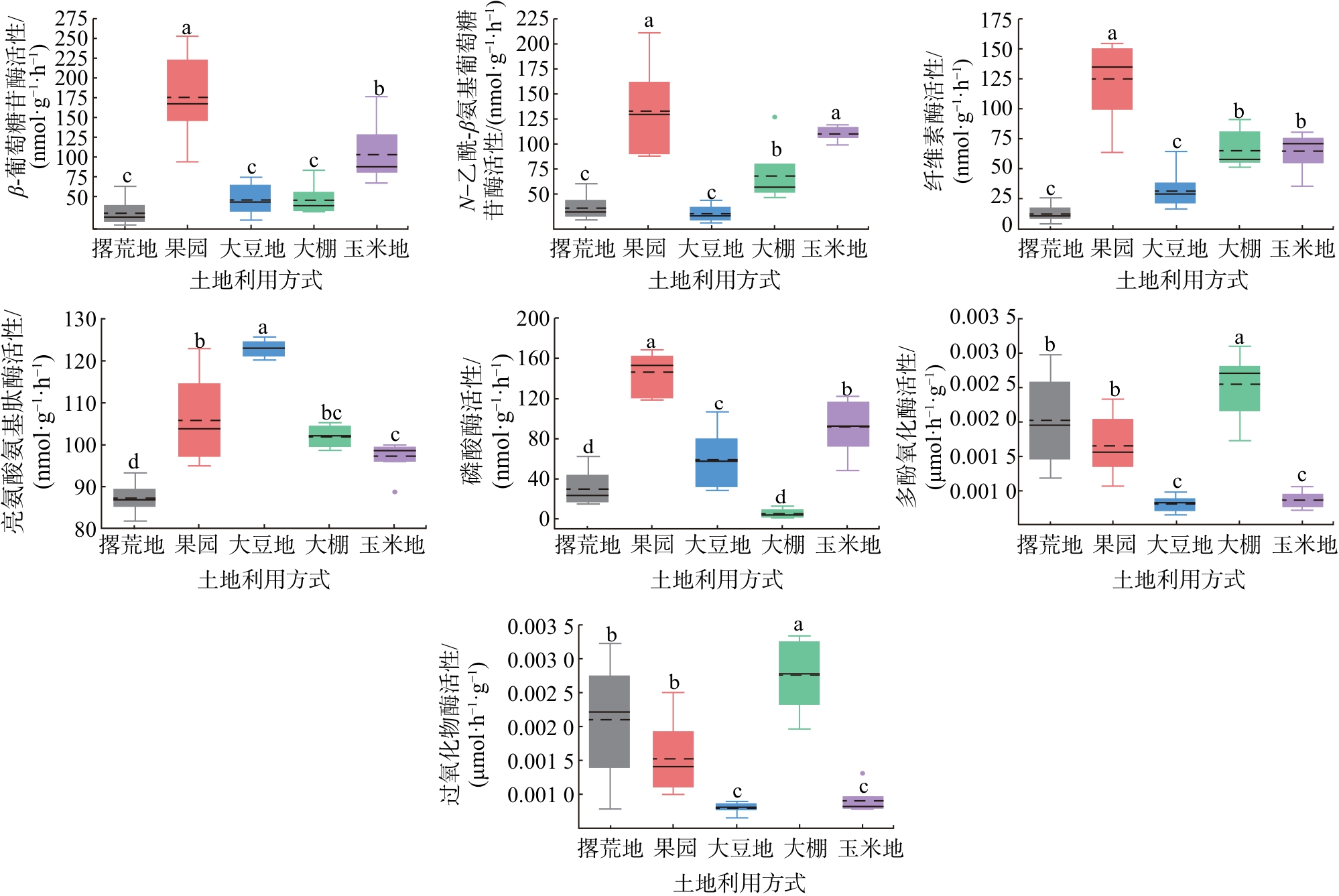
Fig.1 Effects of different land use patterns on soil enzyme activities
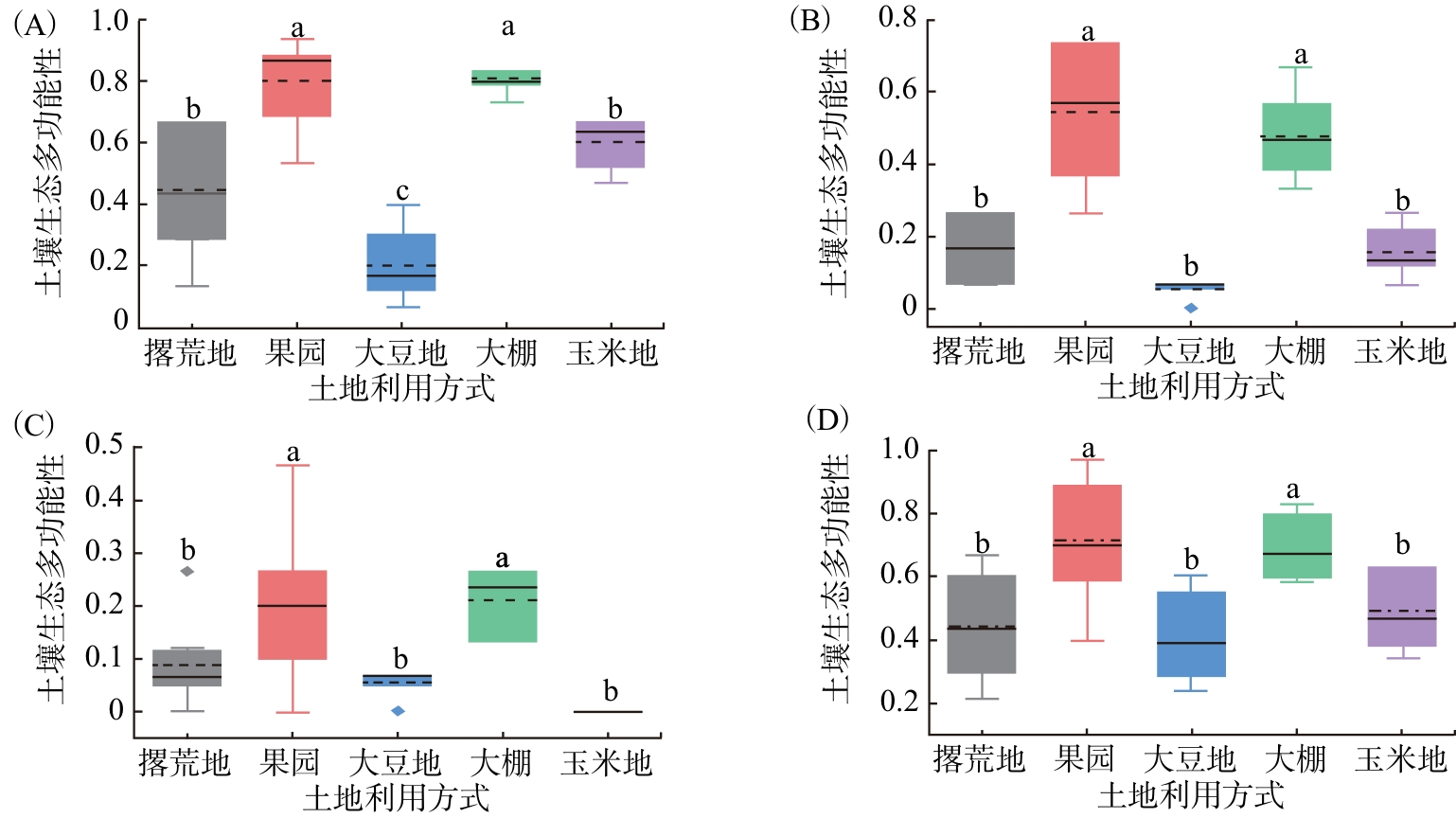
Fig.2 Soil EMF under different land use patterns
| 指标 | 撂荒地 | 果园 | 大豆地 | 大棚 | 玉米地 | |
|---|---|---|---|---|---|---|
| 细菌 | 香农指数 | 7.19±0.16 a | 7.22±0.05 a | 6.92±0.19 b | 7.08±0.11 ab | 6.56±0.21 c |
| 辛普森指数 | 0.001 9±0 bc | 0.001 7±0 c | 0.002 9±0 b | 0.002 0±0 bc | 0.004 7±0 a | |
| Chao1指数 | 2 684.08±280.40 ab | 2 931.34±182.50 a | 2 334.42±372.40 bc | 2 704.78±428.80 ab | 2 032.27±257.30 c | |
| ACE指数 | 2 698.83±283.60 ab | 2 950.42±182.80 a | 2 342.68±374.80 bc | 2 726.87±443.30 ab | 2 045.67±259.30 c | |
| 真菌 | 香农指数 | 4.85±0.28 a | 4.41±0.23 ab | 3.85±0.29 bc | 3.73±0.51 bc | 3.39±1.06 c |
| 辛普森指数 | 0.03±0.02 a | 0.04±0.01 a | 0.07±0.03 a | 0.06±0.03 a | 0.16±0.24 a | |
| Chao1指数 | 721.37±96.59 a | 677.34±70.31 a | 488.37±65.62 b | 396.25±64.75 c | 375.12±81.42 c | |
| ACE指数 | 722.65±97.09 a | 681.70±73.33 a | 490.32±65.85 b | 397.95±66.47 c | 380.35±79.24 c | |
Table 2 Effect of different land use patterns on bacterial and fungal alpha diversity
| 指标 | 撂荒地 | 果园 | 大豆地 | 大棚 | 玉米地 | |
|---|---|---|---|---|---|---|
| 细菌 | 香农指数 | 7.19±0.16 a | 7.22±0.05 a | 6.92±0.19 b | 7.08±0.11 ab | 6.56±0.21 c |
| 辛普森指数 | 0.001 9±0 bc | 0.001 7±0 c | 0.002 9±0 b | 0.002 0±0 bc | 0.004 7±0 a | |
| Chao1指数 | 2 684.08±280.40 ab | 2 931.34±182.50 a | 2 334.42±372.40 bc | 2 704.78±428.80 ab | 2 032.27±257.30 c | |
| ACE指数 | 2 698.83±283.60 ab | 2 950.42±182.80 a | 2 342.68±374.80 bc | 2 726.87±443.30 ab | 2 045.67±259.30 c | |
| 真菌 | 香农指数 | 4.85±0.28 a | 4.41±0.23 ab | 3.85±0.29 bc | 3.73±0.51 bc | 3.39±1.06 c |
| 辛普森指数 | 0.03±0.02 a | 0.04±0.01 a | 0.07±0.03 a | 0.06±0.03 a | 0.16±0.24 a | |
| Chao1指数 | 721.37±96.59 a | 677.34±70.31 a | 488.37±65.62 b | 396.25±64.75 c | 375.12±81.42 c | |
| ACE指数 | 722.65±97.09 a | 681.70±73.33 a | 490.32±65.85 b | 397.95±66.47 c | 380.35±79.24 c | |
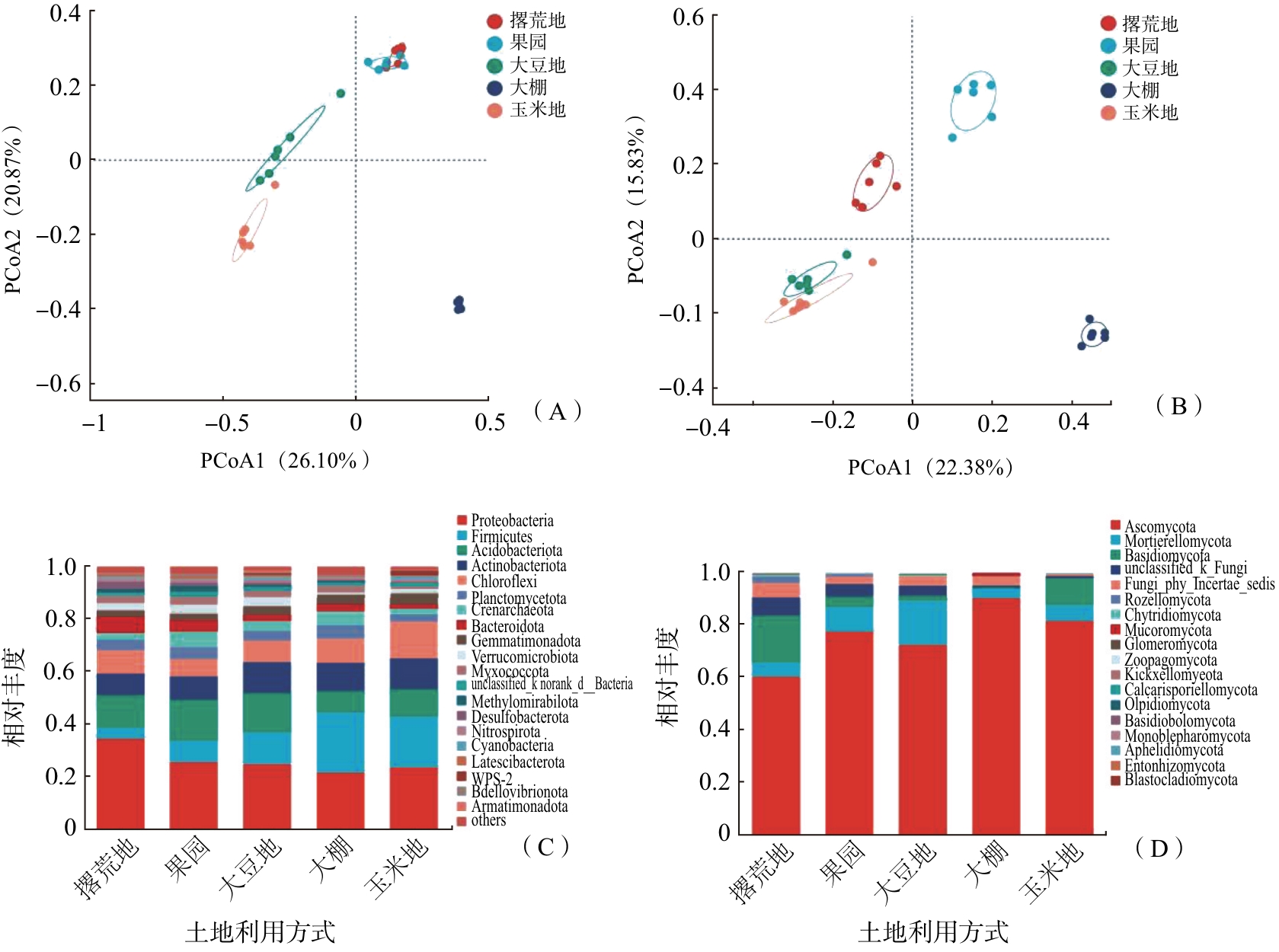
Fig.3 Principal coordinate analysis(A,B)and species composition(C,D)of soil bacterial(A,C)and fungal(B,D)communities under different land use patterns
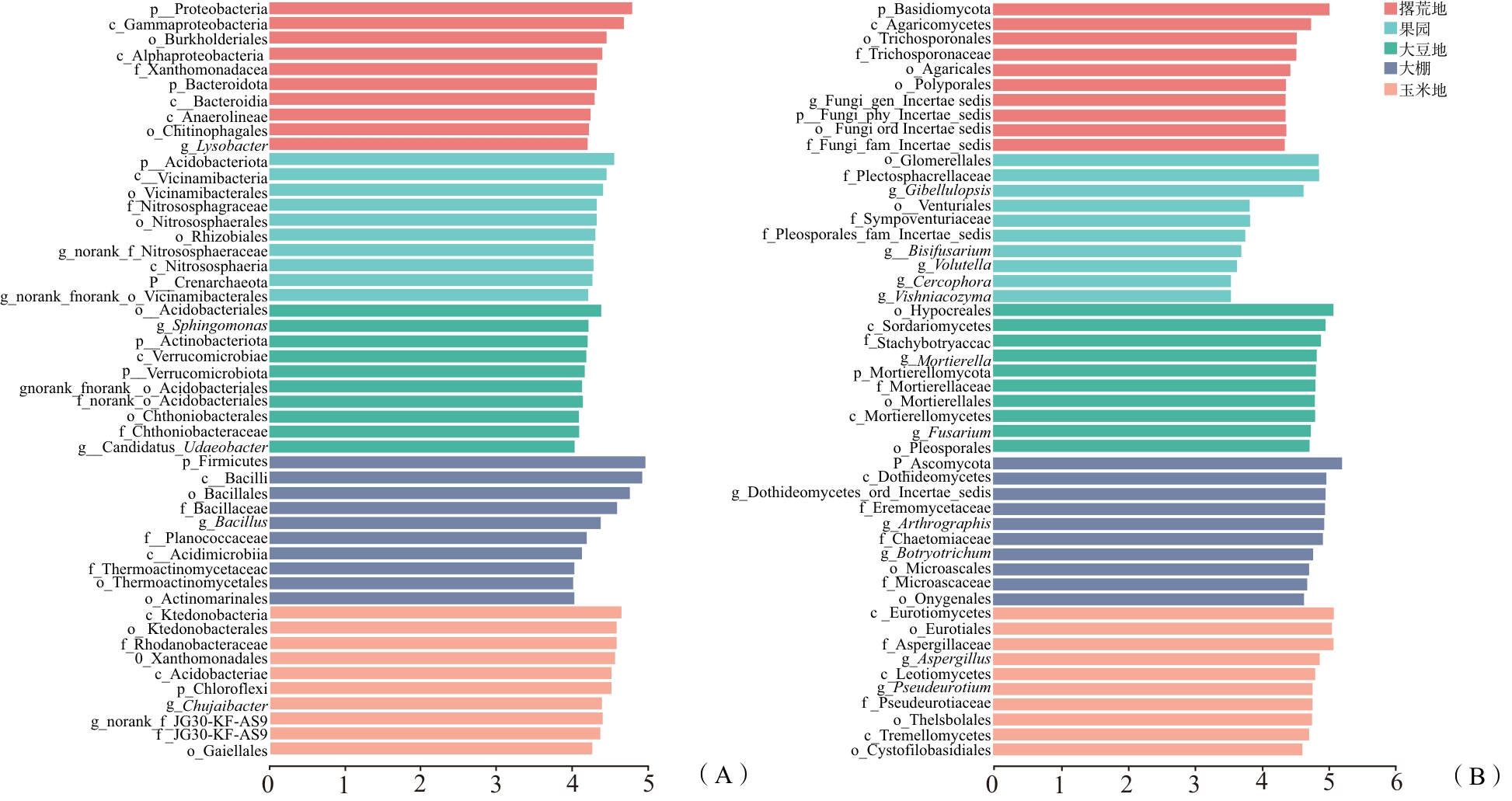
Fig.4 LEfSe analysis of soil bacteria(A)and fungi(B)under different land use patterns
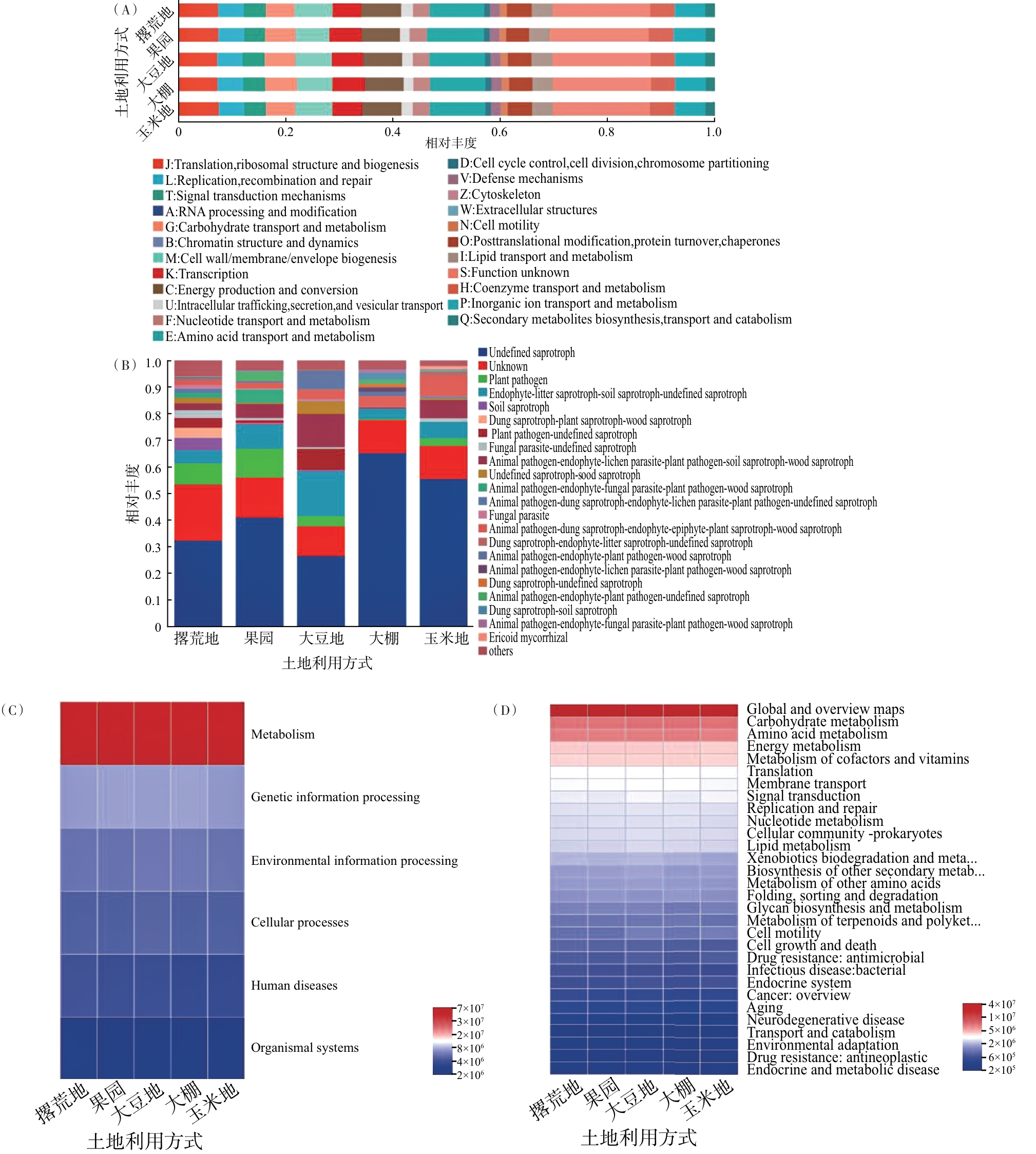
Fig.5 Functional gene composition of soil microorganism under different land use patterns
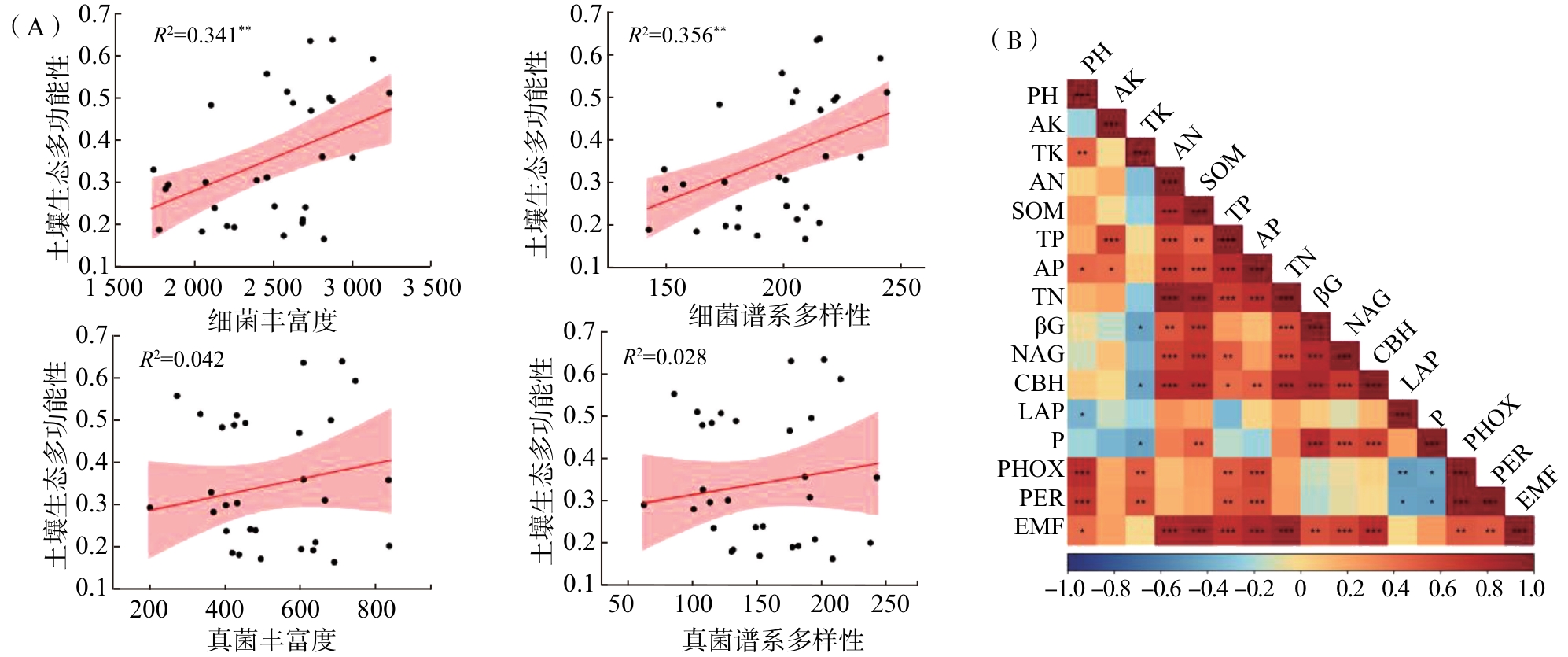
Fig.6 Linear relationship between microbial(bacteria,fungi)richness,phylogenetic diversity and ecosystem multifunctionality(A)and the correlation between soil ecosystem multifunctionality(EMF)and physical and chemical indicators(B)
| [50] | Shaffique S, Khan M A, Imran M,et al. Research progress in the field of microbial mitigation of drought stress in plants[J]. Frontiers in Plant Science,2022,13:870626. |
| [51] | Delgado-Baquerizo M, Maestre F T, Reich P B,et al. Microbial diversity drives multifunctionality in terrestrial ecosystems[J]. Nature Communications,2016,7:10541. |
| [52] | 陆思旭,贺丽燕,王旭东. 耕作措施对玉米田耕层土壤微生物群落功能多样性的影响[J]. 干旱地区农业研究,2020,38(5):15-22. |
| [53] | Lehmann J, Kleber M. The contentious nature of soil organic matter[J]. Nature,2015,528(7580):60-68. |
| [1] | 王凯,王聪,冯晓明,等. 生物多样性与生态系统多功能性的关系研究进展[J]. 生态学报,2022,42(1):11-23. |
| [2] | 赵慧英,王海燕. 土壤多功能性及其驱动因素研究进展[J]. 应用与环境生物学报,2024,30(3):615-622. |
| [3] | 李世贵,吕天晓,顾金刚,等. 土壤微生物分子生态学研究方法[J]. 中国土壤与肥料,2008(6):1-4. |
| [4] | Huang Q, Wang J L, Wang C,et al. The 19-years inorganic fertilization increased bacterial diversity and altered bacterial community composition and potential functions in a paddy soil[J]. Applied Soil Ecology,2019,144:60-67. |
| [5] | Kennedy A C. Bacterial diversity in agroecosystems[J]. Agriculture,Ecosystems Environment,1999,74(1/2/3):65-76. |
| [6] | Singh B K, Bardgett R D, Smith P,et al. Microorganisms and climate change:terrestrial feedbacks and mitigation options[J]. Nature Reviews Microbiology,2010,8(11):779-790. |
| [7] | Zhou J Z, Deng Y, Luo F,et al. Phylogenetic molecular ecological network of soil microbial communities in response to elevated CO2 [J]. MBio,2011,2(4):e00122-e00111. |
| [8] | Bragazza L, Parisod J, Buttler A,et al. Biogeochemical plant-soil microbe feedback in response to climate warming in peatlands[J]. Nature Climate Change,2013,3(3):273-277. |
| [9] | de Vries F T, Griffiths R I, Bailey M,et al. Soil bacterial networks are less stable under drought than fungal networks[J]. Nature Communications,2018,9:3033. |
| [10] | Chen Q L, Cui H L, Su J Q,et al. Antibiotic resistomes in plant microbiomes[J]. Trends in Plant Science,2019,24(6):530-541. |
| [11] | Wagg C, Bender S F, Widmer F,et al. Soil biodiversity and soil community composition determine ecosystem multifunctionality[J]. Proceedings of the National Academy of Sciences of the United States of America,2014,111(14):5266-5270. |
| [12] | 郑佳华,赵萌莉,王琪,等. 不同利用方式对大针茅草原生态系统多功能性的影响[J]. 草地学报,2022,30(5):1054-1062. |
| [13] | 及利,杨雨春,王君,等. 不同土地利用方式下酚酸物质与土壤微生物群落的关系[J]. 生态学报,2019,39(18):6710-6720. |
| [14] | Yang Y, Chai Y B, Xie H J,et al. Responses of soil microbial diversity,network complexity and multifunctionality to three land-use changes[J]. Science of the Total Environment,2023,859:160255. |
| [15] | Zhou T R, Lv Q L, Zhang L X,et al. Converted paddy to upland in saline-sodic land could improve soil ecosystem multifunctionality by enhancing soil quality and alleviating microbial metabolism limitation[J]. Science of the Total Environment,2024,924:171707. |
| [16] | Banerjee S, Thrall P H, Bissett A,et al. Linking microbial co-occurrences to soil ecological processes across a woodland-grassland ecotone[J]. Ecology and Evolution,2018,8(16):8217-8230. |
| [17] | Yang X, You L C, Hu H W,et al. Conversion of grassland to cropland altered soil nitrogen-related microbial communities at large scales[J]. Science of the Total Environment,2022,816:151645. |
| [18] | 李泽波,成雅君,蔡诗文,等. 桉树人工林土壤生态系统多功能性对改造措施的响应[J]. 桉树科技,2024,41(3):15-20. |
| [19] | 鲍士旦. 土壤农化分析[M]. 3版. 北京:中国农业出版社,2000. |
| [20] | 李奕赞,张江周,贾吉玉,等. 农田土壤生态系统多功能性研究进展[J]. 土壤学报,2022,59(5):1177-1189. |
| [21] | Qi T Y, Degen A, Wang W Y,et al. Environmental factors and soil properties that drive the distribution and diversity patterns of weeds and ecosystem multifunctionality in Alpine grassland[J]. Biological Conservation,2025,305:111103. |
| [22] | Jia L, Zhang H J, Lu J Y,et al. Green manuring with balanced fertilization improves soil ecosystem multifunctionality by enhancing soil quality and enzyme activities in a smooth vetch-maize rotation system[J]. Agriculture,Ecosystems Environment,2025,387:109632. |
| [23] | 霍皇煜,米琦,周天财,等. 青藏高原高寒草地土壤酶活性海拔地带性特征[J]. 生态学报,2024,44(1):405-415. |
| [24] | 杨帆,徐洋,崔勇,等. 近30年中国农田耕层土壤有机质含量变化[J]. 土壤学报,2017,54(5):1047-1056. |
| [25] | Chen H, Li D J, Zhao J,et al. Effects of nitrogen addition on activities of soil nitrogen acquisition enzymes:a meta-analysis[J]. Agriculture,Ecosystems Environment,2018,252:126-131. |
| [26] | 唐瑞,蒲勇,戴文颖,等. 施氮活化根际土壤磷素促进粗齿冷水花的磷素积累[J]. 植物营养与肥料学报,2023,29(12):2299-2309. |
| [27] | 董秀芹,袁红莉,高同国. 木质素降解酶及相关基因研究进展[J]. 生物技术通报,2014,30(11):62-72. |
| [28] | 邓健,赵雪,卢笑玥,等. 半干旱草地土壤团聚体氮磷转化相关酶活性对氮添加的响应[J]. 生态学报,2023,43(16):6539-6549. |
| [29] | 刘洋荧,王尚,厉舒祯,等. 基于功能基因的微生物碳循环分子生态学研究进展[J]. 微生物学通报,2017,44(7):1676-1689. |
| [30] | 李懿,杨子松. 岷江流域不同土地利用方式下的土壤微生物特征及其与土壤养分的关系[J]. 水土保持研究,2020,27(1):33-38,46. |
| [31] | 张丽,闫倩,王保莉,等. 不同土地利用方式下滨海盐土细菌多样性变化[J]. 西北农业学报,2011,20(8):163-167,198. |
| [32] | Ledo A, Smith P, Zerihun A,et al. Changes in soil organic carbon under perennial crops[J]. Global Change Biology,2020,26(7):4158-4168. |
| [33] | 时鹏,高强,王淑平,等. 玉米连作及其施肥对土壤微生物群落功能多样性的影响[J]. 生态学报,2010,30(22):6173-6182. |
| [34] | 竹兰萍,徐飞,王佳颖,等. 嘉陵江滨岸带不同土地利用类型土壤真菌群落结构与功能多样性[J]. 环境科学,2022,43(12):5808-5818. |
| [35] | 尹国丽,李亚娟,张振粉,等. 不同草田轮作模式土壤养分及细菌群落组成特征[J]. 生态学报,2020,40(5):1542-1550. |
| [36] | 张平究,梁川,陈芳,等. 退耕还湿后土壤细菌群落结构和生物量变化过程[J]. 生态学报,2023,43(11):4747-4759. |
| [37] | 魏志文,李韵雅,江威,等. 无锡地区常见树木根际土壤酸杆菌多样性[J]. 生态学杂志,2018,37(9):2649-2656. |
| [38] | 甫文疆,赵芸晨. 根际与根内细菌非同步响应玉米连作效应研究[J]. 植物营养与肥料学报,2023,29(11):2108-2119. |
| [39] | Wang M, Shi S, Lin F,et al. Response of the soil fungal community to multi-factor environmental changes in a temperate forest[J]. Applied Soil Ecology,2014,81:45-56. |
| [40] | 吴希慧,王蕊,高长青,等. 土地利用驱动的土壤性状变化影响微生物群落结构和功能[J]. 生态学报,2021,41(20):7989-8002. |
| [41] | 白小龙,张恩,武晋民,等. 不同改良物料对盐碱土壤真菌群落结构的影响[J]. 环境科学,2024,45(6):3562-3570. |
| [42] | 宁琪,陈林,李芳,等. 被孢霉对土壤养分有效性和秸秆降解的影响[J]. 土壤学报,2022,59(1):206-217. |
| [43] | 张金波,王永斌,谭巍巍,等. 大豆根际微生物的研究进展[J]. 大豆科学,2024,43(4):471-480. |
| [44] | Zhao W X, Hou R H, Liu M J,et al. Analysis of soil microbial community structure changes in the drainage field of the Shengli coalfield based on high-throughput sequencing[J]. BMC Microbiology,2025,25(1):132. |
| [45] | Huang J Q, Liu X L, Liu J G,et al. Changes of soil bacterial community,network structure,and carbon,nitrogen and sulfur functional genes under different land use types[J]. Catena,2023,231:107385. |
| [46] | Zhu S J, Xu L L, He C Z,et al. Effects of land use type on soil organic carbon in different soil types[J]. Journal of Integrative Agriculture,2026,25(2):540-552. |
| [47] | 黎劼. 病原菌对植物的作用及其受环境因子的影响[J]. 河南科技,2013,32(12):223-223,235. |
| [48] | 陈桂鲜,吴传发,葛体达,等. 土壤多功能性对微生物多样性降低的响应[J]. 环境科学,2022,43(11):5274-5285. |
| [49] | Li M H, Guo J J, Ren T,et al. Crop rotation history constrains soil biodiversity and multifunctionality relationships[J]. Agriculture,Ecosystems Environment,2021,319:107550. |
| [1] | SONG Gen, FAN Yafei, ZHANG Xiufen, SONG Chunguang, JIA Zhenhua, WANG Changsong, FENG Jianlong, WU Yanhong, HAN Lili, GUO Dingxin, CHEN Jie, ZHOU Guoyan. Effects of bio-organic fertilizer on cultivation of drought-alkali resistant wheat and soil properties [J]. Journal of Zhejiang Agricultural Sciences, 2026, 67(7): 1649-1653. |
| [2] | LI Juan, AN Jianhua, WANG Wenhui, LIU Xiaojuan, SHI Juanjuan, WEI Zhouquan. Effect of different crop rotations on root rot and rhizosphere soil fungal communities of Baitiao Codonopsis pilosula [J]. Journal of Zhejiang Agricultural Sciences, 2026, 67(7): 1698-1704. |
| [3] | LYU Yongjie, HAO Ruixin, CHEN Junhong, XU Mingxing, CHENG Min, MA Junwei, WU Shaohua. Threshold response and synergistic driving mechanism of soil organic carbon to environmental factors in Jinyun County,Zhejiang Province [J]. Journal of Zhejiang Agricultural Sciences, 2026, 67(7): 1775-1782. |
| [4] | ZHOU Miao, CAI Wei, XU Jiezhang, LIU Xiaoxia, LIN Baoyi. Effects of seeding rate and rhizobium inoculation on yield and soil fertility enhancement inChinese milk vetch(Astragalus sinicus L.) [J]. Journal of Zhejiang Agricultural Sciences, 2026, 67(7): 1796-1800. |
| [5] | JIN Yi, LI Haishen, SUN Jian, ZHOU Chaobin, JIANG Ling, HU Chunli, ZHAN Jianyong, WANG Zhi'an. Rhizosphere microbial community characteristics of perennial Hangbaishao in the genuine producing area [J]. Journal of Zhejiang Agricultural Sciences, 2026, 67(7): 1801-1811. |
| [6] | ZHANG Jiajia. Effects of different grass types on soil properties and fruit quality in a mountain Myrica rubra orchard [J]. Journal of Zhejiang Agricultural Sciences, 2026, 67(6): 1366-1370. |
| [7] | WU Hao, LI Junbing, XU Jigen, ZHANG Shunchang, SHEN Xuancai, LUO Xuhui, HE Fengjie, CHENG Jianhui. Effects of different base fertilizers on the soil physicochemical properties and fruit quality of vineyard [J]. Journal of Zhejiang Agricultural Sciences, 2026, 67(6): 1511-1517. |
| [8] | LI Jie, ZHANG Guangting, LIU Yuhong, ZHANG Hang, PANG Meirong, SUN Caixia. Comprehensive evaluation of Haining pear quality and soil quality based on the entropy⁃weighted TOPSIS method [J]. Journal of Zhejiang Agricultural Sciences, 2026, 67(5): 1151-1157. |
| [9] | SU Guijun, CHENG Jingwen, LOU Ling, PANG Yinghua, GU Wanfan, SHEN Jianguo, CHEN Haoran. Effects of fluridine application rates on soil microbial environment,disease resistance and yield of Chinese cabbage in facility soil [J]. Journal of Zhejiang Agricultural Sciences, 2026, 67(5): 1286-1289. |
| [10] | WANG Pingsong, LI Hongxian, LI Shaoxing, WU Chaohui, YUAN Qingting, ZHU Ling, LEI Zhongmao, CHEN Chaojiang, WAN Zuxuan, CAI Yiyang. Effects of biomass ash on tobacco-planting soil and flue-cured tobacco [J]. Journal of Zhejiang Agricultural Sciences, 2026, 67(5): 1301-1307. |
| [11] | LIU Yingchun, ZHONG Dongdong, SHEN Chao, WANG Xiaoyan, LI Yonggang, LIU Shangmin, DONG Hegan. Effect of cotton straw returning to the field in arid areas on soil physical and chemical properties and cotton yield [J]. Journal of Zhejiang Agricultural Sciences, 2026, 67(4): 1006-1011. |
| [12] | JIANG Zhenghang, YING Shanshan, ZHU Yuezhong, XU Jiezhang, HUANG Zhangting. Effect of different straw returning treatments on crop yield and soil quality in rice⁃wheat rotation system [J]. Journal of Zhejiang Agricultural Sciences, 2026, 67(4): 1012-1017. |
| [13] | ZHOU Yifan, LI Zhiqi, CAI Guoxue, LI Siguang, PENG Qing, ZHAO Jingkun, WANG Jie, SHI Xiaojun. Combined application of nitrogen,phosphorus,and potassium fertilizers on yield and nutrient uptake of sorghum-rape rotation [J]. Journal of Zhejiang Agricultural Sciences, 2026, 67(4): 884-892. |
| [14] | YE Fang, WANG Linwei, SHEN Yimin, WU Yuyong, WANG Yuying. Effect of organic fertilizer replacing chemical fertilizer on the quality and soil physical and chemical properties of Myrica rubra [J]. Journal of Zhejiang Agricultural Sciences, 2026, 67(4): 958-962. |
| [15] | LI Hanwen, HUANG Qinchao, JIAO Yusheng, WANG Peng, ZHANG Yungui, LI Zhihong, LIU Qingli, WANG Ning, JIANG Yuzhou. Soil nutrient characteristics and fertility evaluation of tobacco⁃growing regions in Heilongjiang Province [J]. Journal of Zhejiang Agricultural Sciences, 2026, 67(4): 993-998. |
| Viewed | ||||||
|
Full text |
|
|||||
|
Abstract |
|
|||||
