浙江农业科学 ›› 2026, Vol. 67 ›› Issue (6): 1485-1493.DOI: 10.16178/j.issn.0528-9017.20231149

• 经济作物 • 上一篇    下一篇

高粱-油菜轮作体系下干物质周年累积、养分吸收和分配规律

宁强1(), 赵敬坤2, 王帅2, 李志琦3(), 蔡国学3, 李四光3, 尚城3, 彭清3, 杜川3, 王洋3, 石孝均1,4, 王洁1,4()   

  1. 1.西南大学 资源环境学院,农业农村部西南耕地保育重点实验室,重庆 400716
    2.重庆市农业技术推广总站,重庆 400716
    3.重庆市江津区农业技术推广中心,重庆 402260
    4.国家紫色土肥力与肥料效益监测基地,重庆 400716
  • 收稿日期:2023-11-30 出版日期:2026-06-11 发布日期:2026-06-12
  • 通讯作者: 李志琦,王洁
  • 作者简介:王洁,E-mail:mutouyu@swu.edu.cn
    李志琦,E-mail:105347334@qq.com
    宁强,主要从事养分资源管理研究。E-mail:1205541794@qq.com
  • 基金资助:
    重庆英才计划“包干制”项目(cstc2021ycjh-bgzxm0323);重庆市自然科学基金面上项目(CSTB2022NSCQ-MSX1489)

Annual dry matter accumulation,nutrient uptake and distribution patterns in sorghum-rapeseed rotation system

NING Qiang1(), ZHAO Jingkun2, WANG Shuai2, LI Zhiqi3(), CAI Guoxue3, LI Siguang3, SHANG Cheng3, PENG Qing3, DU Chuan3, WANG Yang3, SHI Xiaojun1,4, WANG Jie1,4()   

  1. 1.Key Laboratory of Arable Land Conservation for Southwest China,Ministry of Agriculture and Rural Affairs,College of Resources and Environment,Southwest University,Chongqing 400716
    2.Agricultural Technology Extension Station in Chongqing City,Chongqing 400716
    3.Agricultural Technology Extension Center of Jiangjin District,Chongqing City,Chongqing 402260
    4.National Monitoring Base for Purple Soil Fertility and Fertilizer Efficiency,Chongqing 400716
  • Received:2023-11-30 Online:2026-06-11 Published:2026-06-12
  • Contact: LI Zhiqi,WANG Jie

摘要:

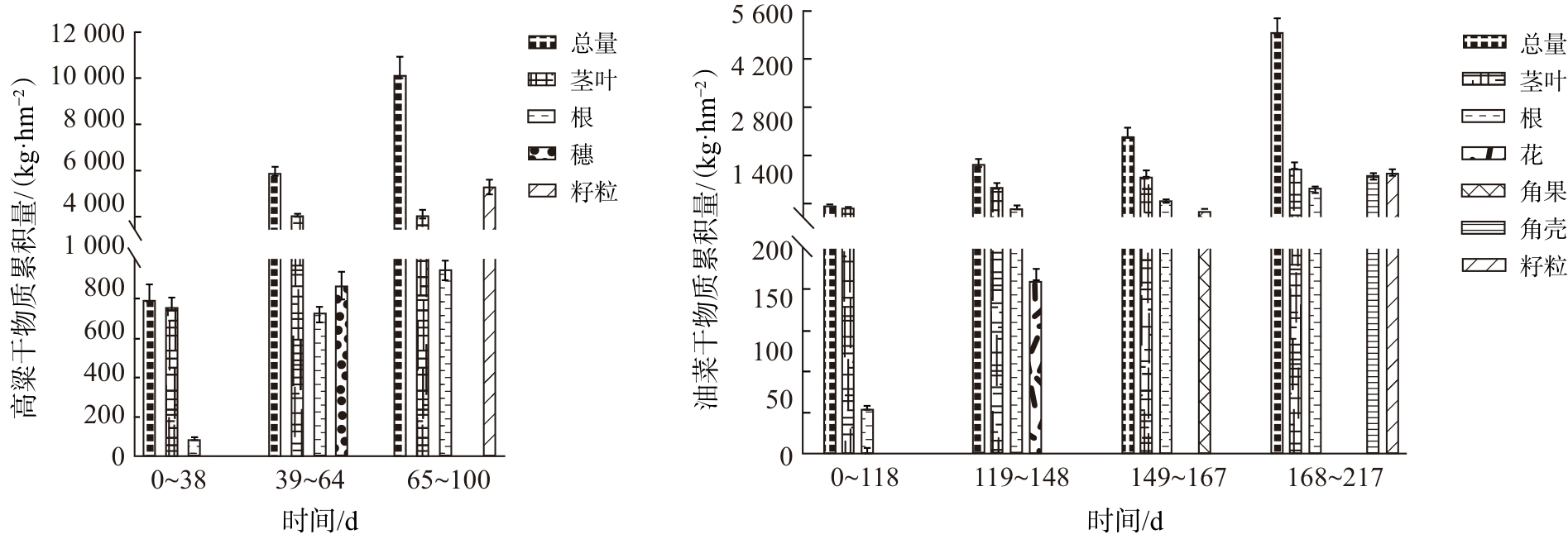
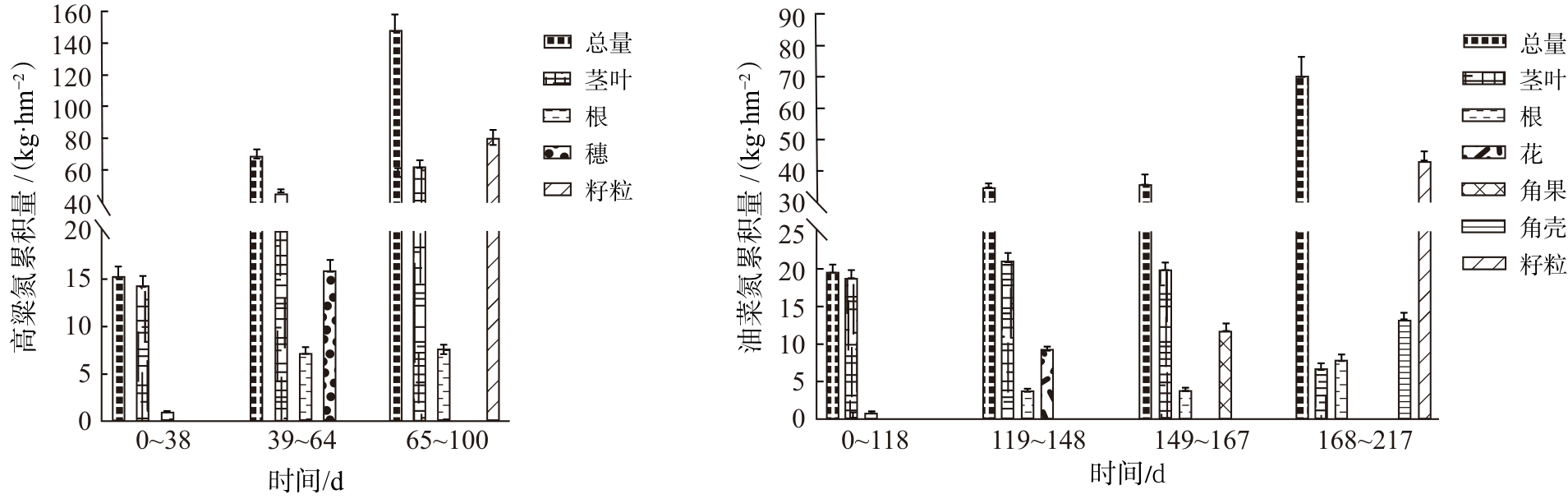
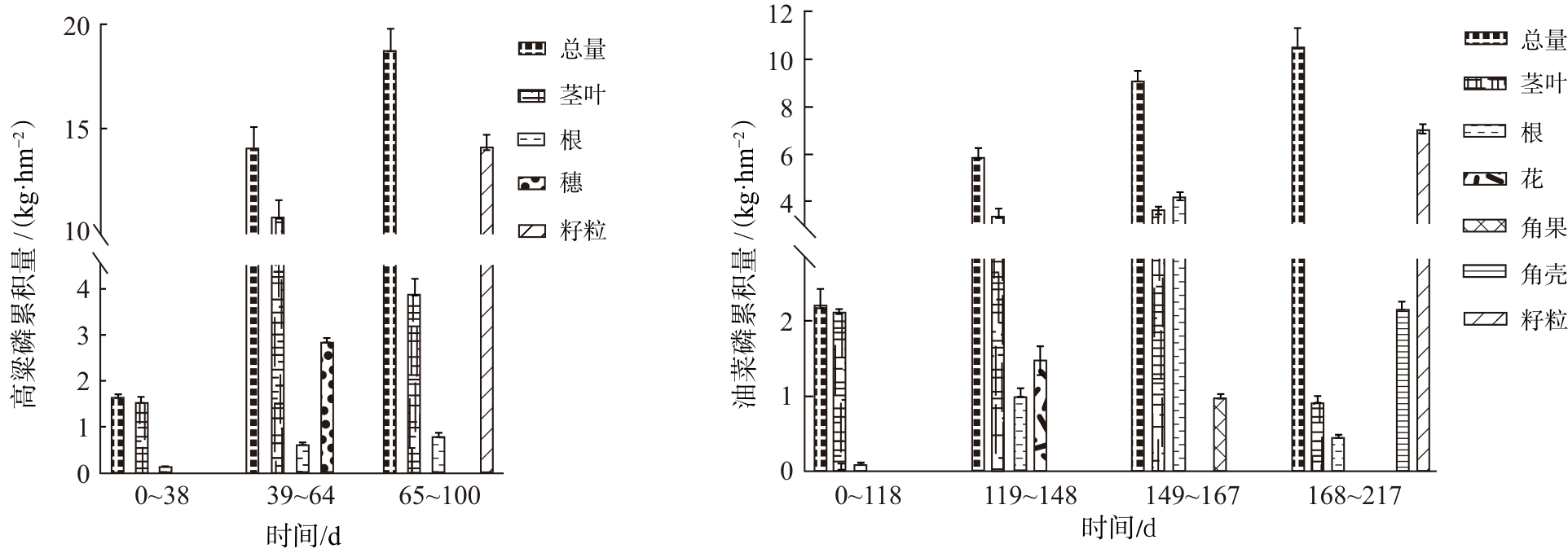
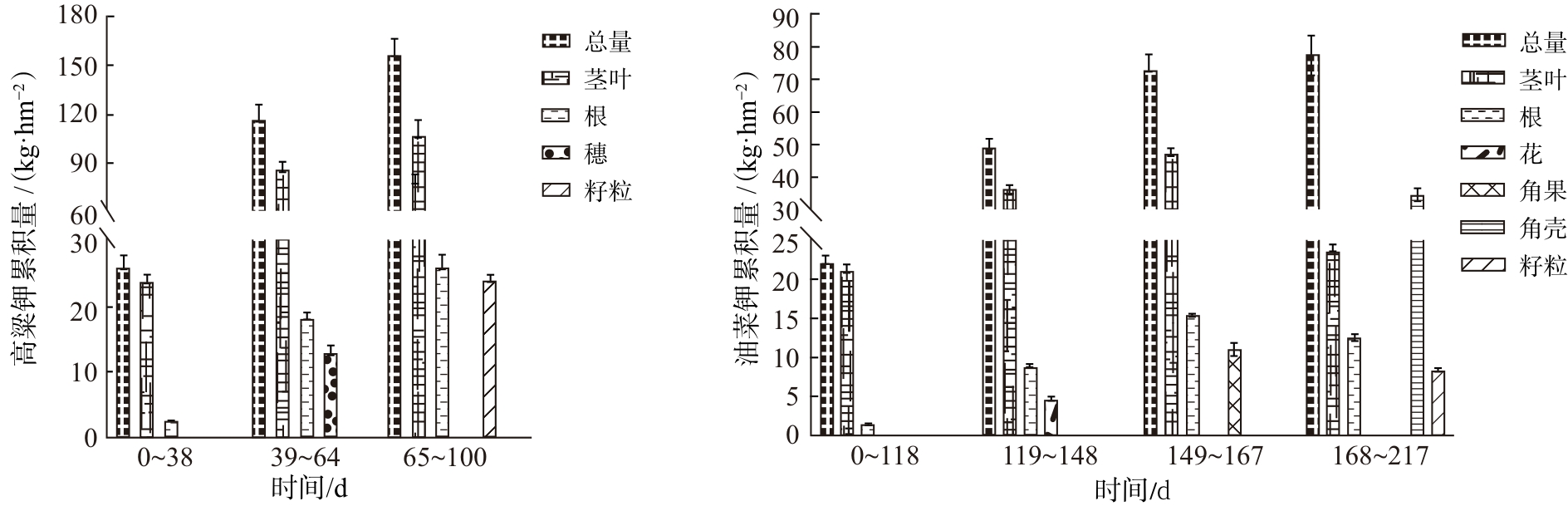
为明确高粱-油菜轮作模式的干物质积累特征及氮、磷、钾养分吸收分配规律,并为精准施肥提供理论依据,于2020年9月至2022年8月开展了田间定位试验。在高粱和油菜的关键生育期进行整株采样,测定不同器官的干物质积累量及氮、磷、钾养分含量。结果表明:高粱与油菜的干物质积累均呈“前慢后快”的特征。高粱成熟收获时,干物质积累量表现为籽粒>茎叶>根;油菜成熟收获时,干物质积累量表现为茎叶>籽粒>角壳>根。养分吸收具有显著阶段特异性:高粱在39~64 d为磷、钾吸收关键期(需求占比分别为67.0%、57.7%),65~100 d为氮吸收核心期(需求占比54.2%);油菜在119~148 d磷、钾需求占比均超过30%,成熟期(168~217 d)氮需求占比达49.7%。高粱-油菜轮作系统中,籽粒所需氮、磷、钾平均值分别为35、11、46 g·kg?1,其中高粱籽粒分别为24、7、31 g·kg?1,油菜籽粒分别为45、15、60 g·kg?1。本研究明确了高粱-油菜轮作各生育阶段的养分需求特征,为该模式的科学施肥提供了数据支撑。

关键词: 高粱-油菜轮作, 养分吸收, 生育期, 干物质积累

Abstract:

To clarify the characteristics of dry matter accumulation and the patterns of nitrogen,phosphorus,and potassium uptake and distribution in a sorghum-rapeseed rotation system,and to provide a theoretical basis for precision fertilization,a field positioning experiment was conducted from September 2020 to August 2022. Whole-plant sampling was performed at key growth stages of sorghum and rapeseed to determine dry matter accumulation and nitrogen,phosphorus,and potassium contents in different organs. The results showed that dry matter accumulation in both sorghum and rapeseed followed a "slow then fast" pattern. At maturity of sorghum,dry matter accumulation ranked as grain > stem and leaf > root;at maturity of rapeseed,dry matter accumulation ranked as stem and leaf > grain > pod shell > root. Nutrient uptake exhibited significant stage specificity:for sorghum,the critical period for phosphorus and potassium uptake was 39-64 d(accounting for 67.0% and 57.7% of demand,respectively),and the core period for nitrogen uptake was 65-100 d(accounting for 54.2% of demand);for rapeseed,the demand for phosphorus and potassium both exceeded 30% during 119-148 d,and nitrogen demand reached 49.7% during the mature stage(168-217 d). In the sorghum-rapeseed rotation system,the nitrogen,phosphorus,and potassium required for grain production were 35,11,and 46 g·kg-1 in average,respectively,among which sorghum grain accounted for 24,7,and 31 g·kg-1,and rapeseed grain accounted for 45,15,and 60 g·kg-1. This study clarifies the nutrient demand characteristics at each growth stage of the sorghum-rapeseed rotation system,providing data support for scientific fertilization in this system.

Key words: sorghum-rapeseed rotation, nutrient uptake, growth stage, dry matter accumulation

中图分类号: