浙江农业科学 ›› 2026, Vol. 67 ›› Issue (10): 2364-2369.DOI: 10.16178/j.issn.0528-9017.20260525

• 经济作物 • 上一篇    下一篇

滴灌带配置对棉花产量、品质和灌溉水利用效率的影响

李慧琴1(), 王刚2, 马晓梅2, 章莲2, 高波3, 张得林4, 刘英刚5, 王潭刚5()   

  1. 1.石河子农业科学研究院,新疆 石河子 832000
    2.新疆农垦科学院,新疆 石河子 832000
    3.沃达农业科技股份有限公司,新疆 石河子 832000
    4.新疆生产建设兵团科技发展促进中心,新疆 乌鲁木齐 830002
    5.新疆生产建设兵团第三师农业科学研究所,新疆 图木舒克 843900
  • 收稿日期:2026-07-17 出版日期:2026-10-11 发布日期:2026-10-19
  • 通讯作者: 王潭刚
  • 作者简介:王潭刚,E-mail:381762798@qq.com。
    李慧琴,研究方向为大田农作物水肥一体化栽培技术。E-mail:361837637@qq.com。
  • 基金资助:
    兵团天山英才青年拔尖人才项目(2024TSYCCX0110);新疆维吾尔自治区重大科技专项(2024A02002-5);国家重点研发计划项目(2024YFD1200303);兵团科技特派员创新创业专项(2021CB047)

Effects of drip tape configuration on cotton yield,quality and irrigation water use efficiency

LI Huiqin1(), WANG Gang2, MA Xiaomei2, ZHANG Lian2, GAO Bo3, ZHANG Delin4, LIU Yinggang5, WANG Tangang5()   

  1. 1.Shihezi Academy of Agricultural Sciences,Shihezi 832000,Xinjiang
    2.Xinjiang Academy of Agricultural and Reclamation Sciences,Shihezi 832000,Xinjiang
    3.Woda Agricultural Technology Co. ,Ltd. ,Shihezi 832000,Xinjiang
    4.Xinjiang Production and Construction Corps Science and Technology Development Promotion Center,Urumqi 830002,Xinjiang
    5.Third Division Agricultural Research Institute,Xinjiang Production and Construction Corps,Tumxuk 843900,Xinjiang
  • Received:2026-07-17 Online:2026-10-11 Published:2026-10-19
  • Contact: WANG Tangang

摘要:

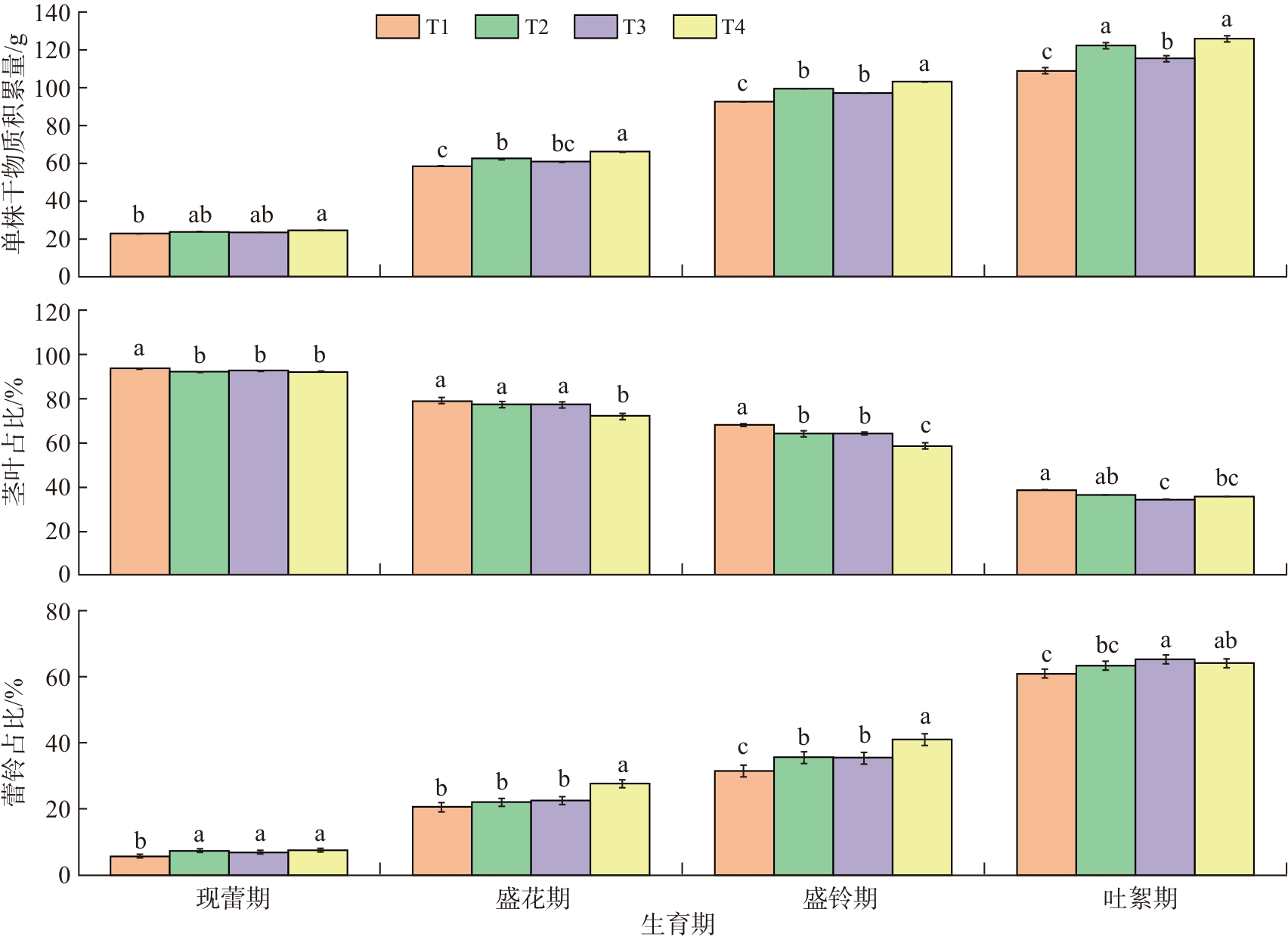
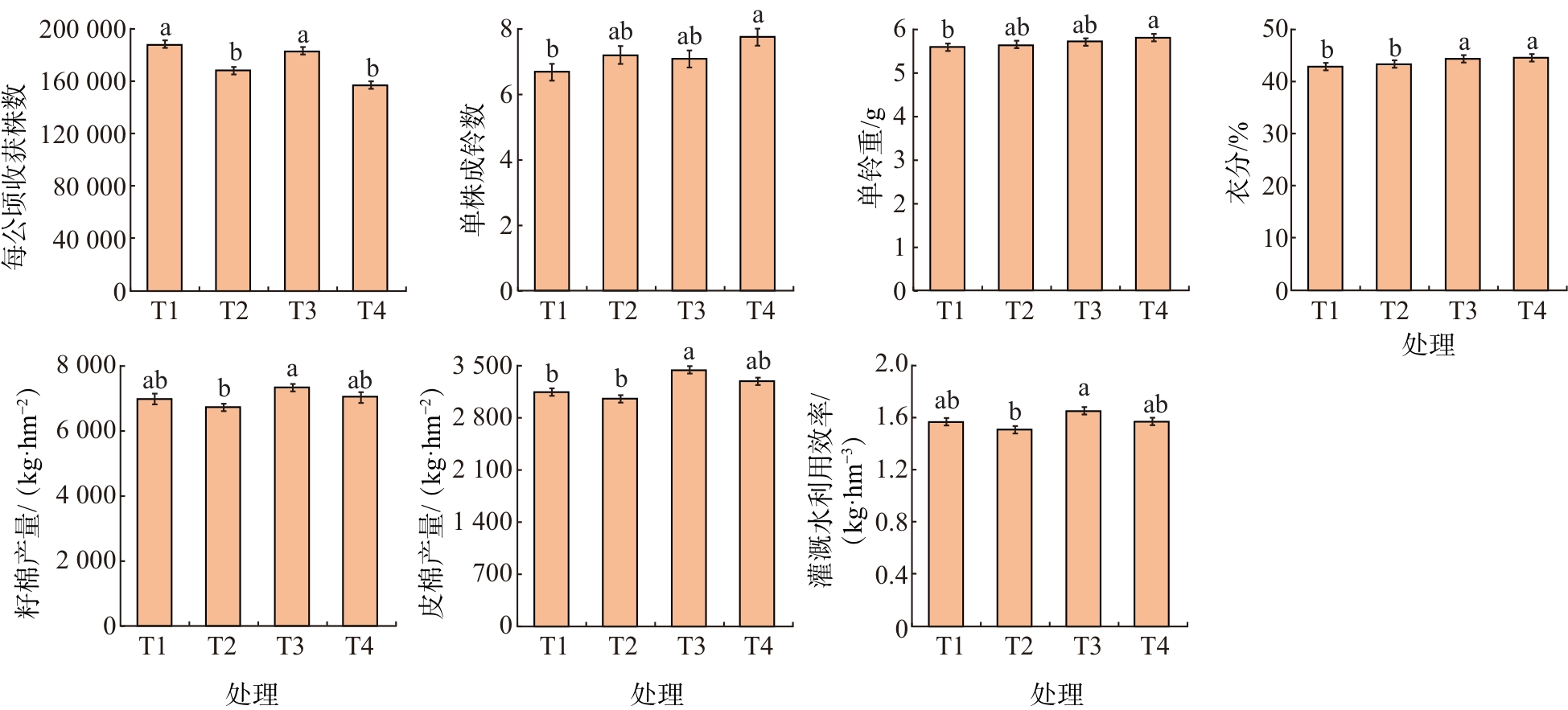
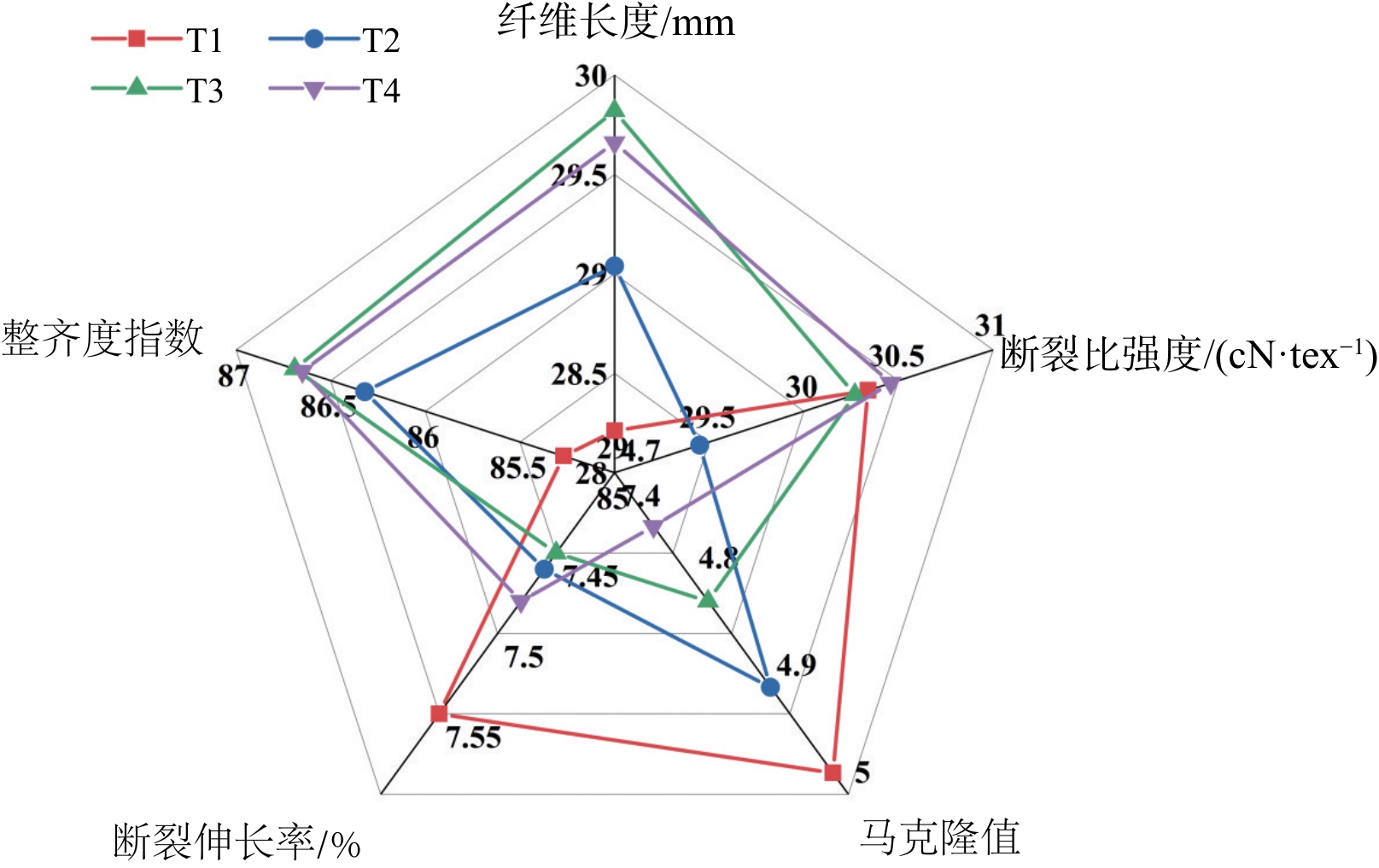
针对新疆干旱区水资源短缺与棉花高产优质协同提升的技术瓶颈,本研究比较了2种主推滴灌带配置与2种种植模式的组合效应,明确其对棉花生长、产量、品质及灌溉水利用效率的调控规律,为区域棉花高效栽培提供理论依据。以侧翼迷宫式和内嵌贴片式滴灌带为材料,设置1膜6行3带、1膜3行3带2种种植模式,共4个组合处理(T1~T4)。结果表明:T4处理(内嵌贴片式滴灌带+1膜3行3带)单株长势最优,株高、果枝数均最高,吐絮期蕾铃占比较高,但每公顷的收获株数仅15.64万,最终籽棉产量和皮棉产量较低;T3处理(内嵌贴片式滴灌带+1膜6行3带)的每公顷收获株数达18.26万,群体与个体协调性最佳,籽棉产量(7 390.52 kg·hm-2)、皮棉产量(3 274.03 kg·hm-2)和灌溉水利用效率(1.64 kg·m-3)均居首位,纤维品质综合表现最优,纤维长度29.82 mm,断裂比强度、马克隆值表现均较好;T1、T2处理的产量和纤维品质相对较差。综上,T3处理可实现新疆南疆砂壤土棉区棉花高产、优质与水分高效利用的协同,推荐作为主推配置模式;T4处理单株生产潜力大,适合优质棉定向生产或稀植栽培场景。

关键词: 滴灌带配置, 棉花, 种植模式, 产量, 纤维品质, 灌溉水利用效率

Abstract:

To address the technical bottleneck of water scarcity and the coordinated improvement of high yield and quality in the Xinjiang arid region,this study compared the combined effects of two mainstream drip tape configurations and two planting patterns,and clarified their regulatory effects on cotton growth,yield,quality,and irrigation water use efficiency,aiming to provide a theoretical basis for efficient cotton cultivation in the region. Using side-labyrinth and built-in patch drip tapes as materials,two planting patterns(1 film with 6 rows and 3 tapes,and 1 film with 3 rows and 3 tapes)were set up,with a total of 4 combined treatments(T1-T4). The results showed that T4(built-in patch drip tape + 1 film with 3 rows and 3 tapes)had the best individual plant growth,with the highest plant height and number of fruit branches,and a higher proportion of buds and bolls at the boll-opening stage;however,the harvest plant density was only 156 400 plants per hectare,resulting in relatively low seed cotton and lint yields. T3(built-in patch drip tape + 1 film with 6 rows and 3 tapes)had a harvest density of 182 600 plants per hectare,achieving the best coordination between population and individuals,and ranked first in seed cotton yield(7 390.52 kg·hm-2),lint yield(3 274.03 kg·hm-2),and irrigation water use efficiency(1.64 kg·m-3);it also exhibited the best comprehensive fiber quality,with fiber length of 29.82 mm,good breaking strength,and Micronaire value. The yields and fiber qualities of T1 and T2 were relatively lower. In conclusion,T3 can achieve coordinated improvement of high yield,quality,and water use efficiency in cotton fields with sandy loam soil in southern Xinjiang,and is recommended as the main configuration mode. T4,with high individual plant production potential,is suitable for targeted high-quality cotton production or sparse planting scenarios.

Key words: drip tape configuration, cotton, planting pattern, yield, fiber quality, irrigation water use efficiency

中图分类号: