浙江农业科学 ›› 2026, Vol. 67 ›› Issue (9): 2298-2303.DOI: 10.16178/j.issn.0528-9017.20250423

• 资源与环境 • 上一篇    下一篇

不同餐余有机肥用量对大白菜生长与土壤改良的影响

许海敏1(), 虞鹏程1, 施通武1, 徐强强1, 陈伟2, 叶正钱3()   

  1. 1.台州市椒江区农业技术推广中心,浙江 台州 318000
    2.台州市椒江区植物检疫站,浙江 台州 318000
    3.浙江农林大学 全省土壤修复与质量提升重点实验室,浙江 杭州 311300
  • 收稿日期:2025-06-13 出版日期:2026-09-11 发布日期:2026-09-24
  • 通讯作者: 叶正钱
  • 作者简介:叶正钱,E-mail:yezhq@zafu.edu.cn。
    许海敏,从事土壤肥料技术推广工作。E-mail:603039442@qq.com

Effect of different amounts of meal residue organic fertilizer on the growth of cabbage and soil improvement

XU Haimin1(), YU Pengcheng1, SHI Tongwu1, XU Qiangqiang1, CHEN Wei2, YE Zhengqian3()   

  1. 1.Agricultural Technology Extension Center in Jiaojiang District,Taizhou City,Taizhou 318000,Zhejiang
    2.Plant Quarantine Station in Jiaojiang District,Taizhou City,Taizhou 318000,Zhejiang
    3.Zhejiang Key Laboratory of Soil Remediation and Quality Improvement,Zhejiang A&F University,Hangzhou 311300,Zhejiang
  • Received:2025-06-13 Online:2026-09-11 Published:2026-09-24
  • Contact: YE Zhengqian

摘要:

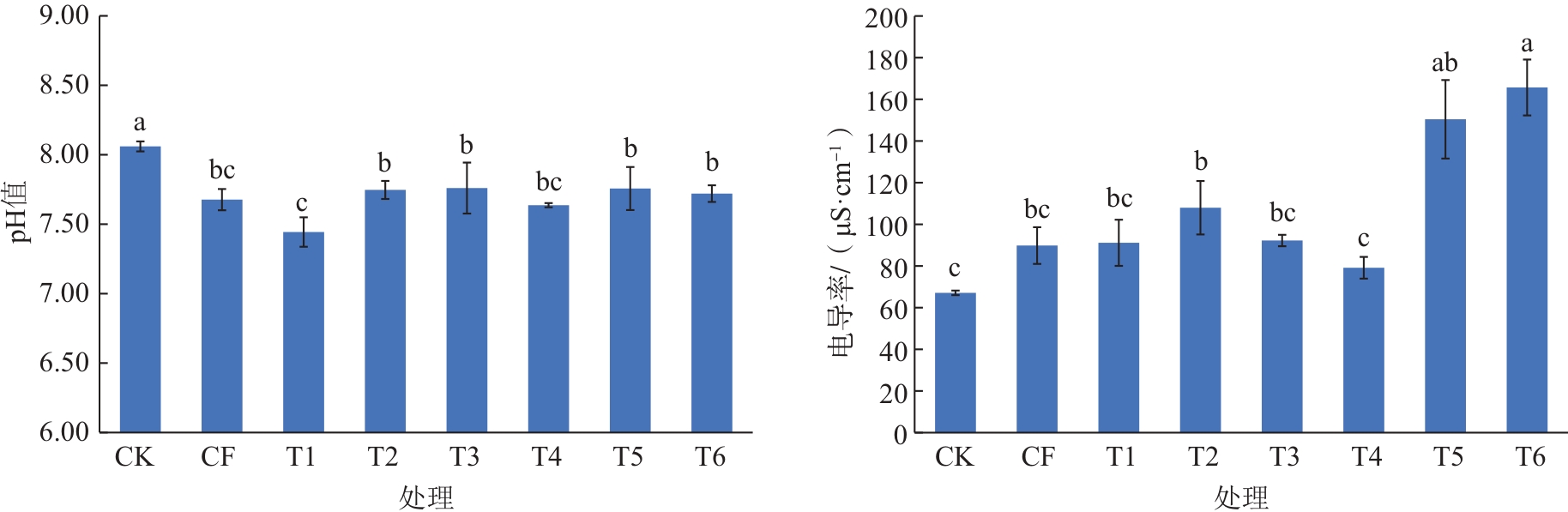
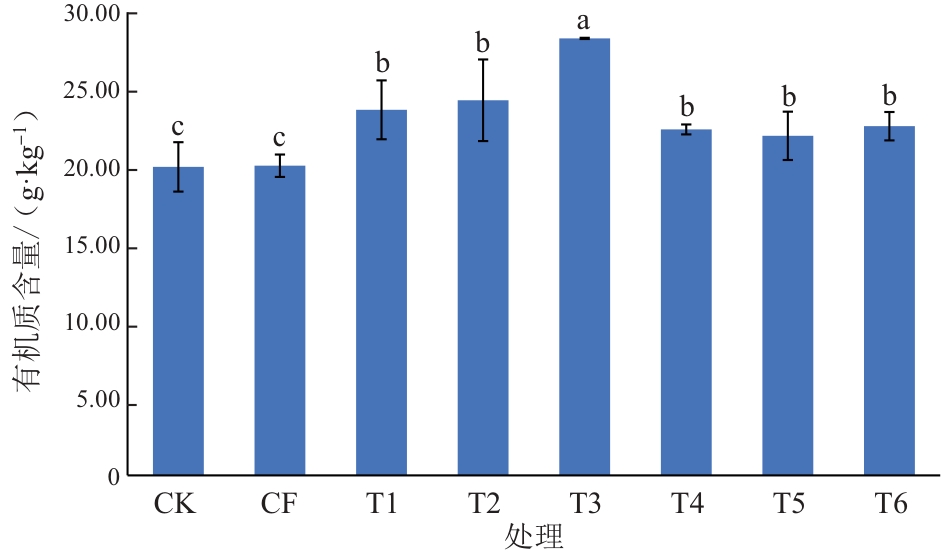
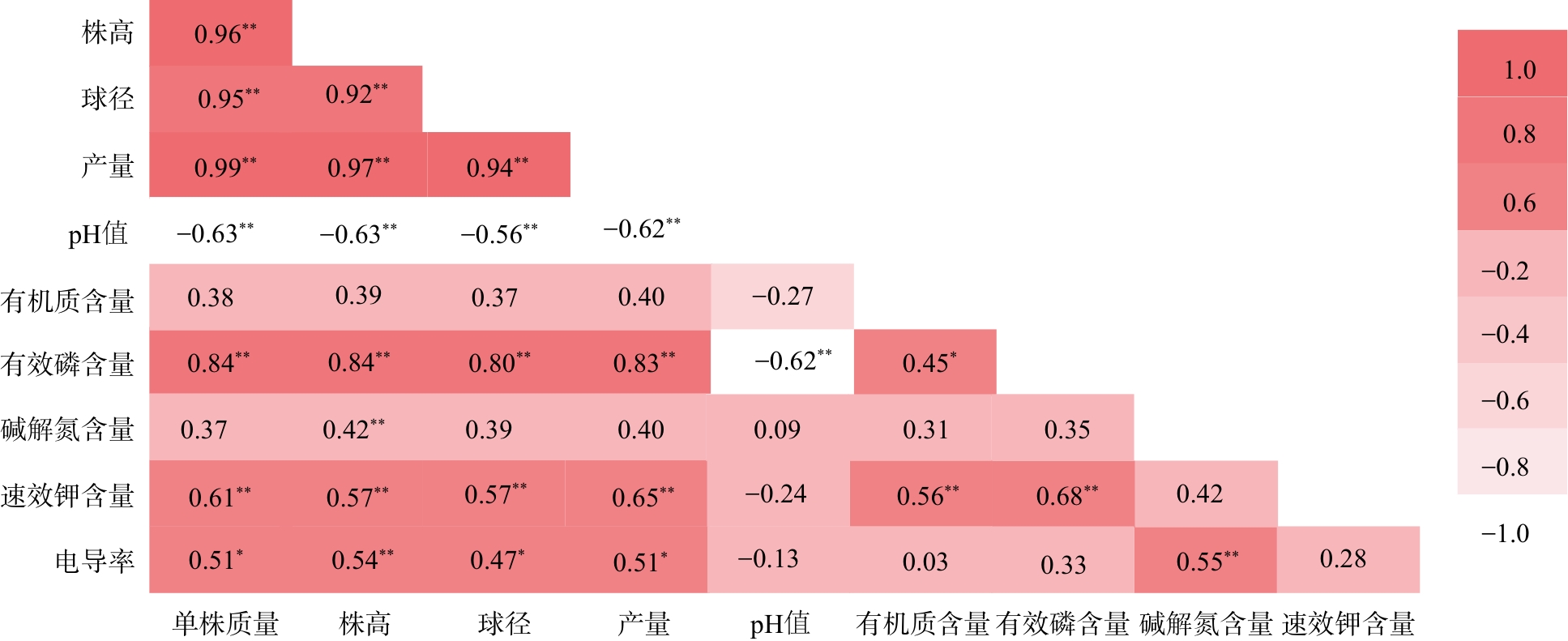
为评价餐余有机肥在蔬菜生产上的效果,以大白菜为试材,设置不施肥(CK)、常规施肥(CF)、化肥减量+不同用量商品有机肥和化肥减量+不同用量餐余有机肥处理,分析不同用量商品有机肥和餐余有机肥对大白菜生长和土壤理化性质、养分含量的影响。结果表明,T6处理(化肥减量+餐余有机肥15 t·hm-2)大白菜产量最高,为128.40 t·hm-2,较CK显著(p<0.05)提高了652.20%。餐余有机肥和商品有机肥在提高大白菜产量方面无显著差异。试验区土壤pH值呈碱性,与CK相比,各施肥处理pH值降幅为3.72%~7.69%。T6处理的土壤电导率最高,较CK显著增加了146.89%。随着餐余有机肥用量的增加,土壤电导率呈上升趋势。T3处理(化肥减量+商品有机肥15 t·hm-2)土壤有机质含量、有效磷含量和速效钾含量最高,分别较CK显著提高了41.64%、83.88%和75.80%。T6处理的碱解氮含量最高,较CK显著提高了15.51%。大白菜的产量与株高、球径、土壤有效磷含量和速效钾含量呈极显著(p<0.01)正相关,与土壤pH值呈极显著负相关,与土壤电导率呈显著正相关。综合分析,化肥减量+餐余有机肥15 t·hm-2最适合大白菜的生长发育,其肥力较好,为大白菜提供了更适宜的生长环境,还能使餐余废弃物得到较好的资源化利用。

关键词: 餐余有机肥, 大白菜, 土壤理化性质, 产量

Abstract:

In order to evaluate the effect of meal residue organic fertilizer in vegetable production,cabbage was used as the test material,and no fertilization(CK),conventional chemical fertilization (CF),chemical fertilizer reduction+different amounts of commercial organic fertilizer or meal residue organic fertilizer were set up to analyze the effects of different amounts of commercial organic fertilizer or meal residue organic fertilizer on the growth of cabbage,soil physical and chemical properties,and nutrients content. The results showed that T6 treatment (chemical fertilizer reduction+15 t·hm-2 meal residue organic fertilizer) had the highest yield of cabbage,reaching 128.40 t·hm-2,which was significantly(p<0.05)increased by 652.20% compared with CK. There was no significant difference in the effect of meal residue organic fertilizer and commercial organic fertilizer on increasing the yield of cabbage. The pH value of the soil in the experimental area was alkaline,and compared with CK,the decrease in each fertilization treatment ranged from 3.72% to 7.69%. The soil electrical conductivity of T6 treatment was the highest,significantly increasing by 146.89% compared with CK. With the increase of amounts of meal residue organic fertilizer,soil electrical conductivity showed an upward trend. The T3 treatment (chemical fertilizer reduction+15 t·hm-2 commercial organic fertilizer) had the highest contents of soil organic matter,available phosphorus,and available potassium,which significantly increased by 41.64%,83.88%,and 75.80% compared with CK. The alkali-hydrolyzable nitrogen content of T6 treatment was the highest,significantly increasing by 15.51% compared with CK. The yield of cabbage was highly significantly(p<0.01)positively correlated with plant height,ball diameter,and soil available phosphorus and available potassium content, highly significantly negatively correlated with soil pH value,and significantly positively correlated with soil electrical conductivity. Based on comprehensive analysis, chemical fertilizer reduction+15 t·hm-2 meal residue organic fertilizer was most suitable for the growth and development of cabbage. Its fertility is good,providing a more suitable growth environment for cabbage and allowing for better resource utilization of meal residues.

Key words: meal residue organic fertilizer, cabbage, soil physical and chemical property, yield

中图分类号: