浙江农业科学 ›› 2026, Vol. 67 ›› Issue (10): 2553-2556.DOI: 10.16178/j.issn.0528-9017.20250319

• 资源与环境 • 上一篇    下一篇

氮肥减量对紫云英还田后水稻产量和磷利用效率的影响

武博1(), 王朝贤1, 张佳佳2()   

  1. 1.苍南县农业农村局,浙江 苍南 325800
    2.温州市植物保护与土壤肥料管理站,浙江 温州 325000
  • 收稿日期:2025-04-30 出版日期:2026-10-11 发布日期:2026-10-19
  • 通讯作者: 张佳佳
  • 作者简介:张佳佳,E-mail:724165539@qq.com。
    武博,主要从事植物保护、植物检疫、土壤肥料技术推广工作。E-mail:569959964@qq.com。

Effect of nitrogen fertilizer reduction on rice yield and phosphorus use efficiency after returning Astragalus sinicus L. to the field

WU Bo1(), WANG Chaoxian1, ZHANG Jiajia2()   

  1. 1.Cangnan County Agriculture and Rural Affaris Bureau,Cangnan 325800,Zhejiang
    2.Wenzhou Plant Protection and Soil Fertilizer Management Station,Wenzhou 325000,Zhejiang
  • Received:2025-04-30 Online:2026-10-11 Published:2026-10-19
  • Contact: ZHANG Jiajia

摘要:

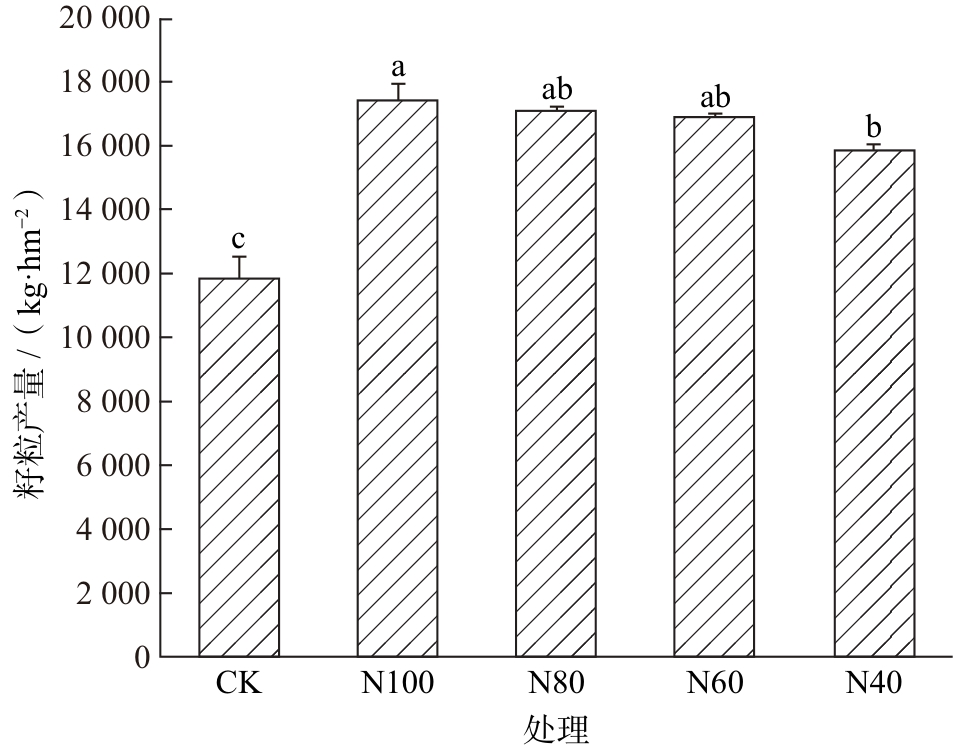
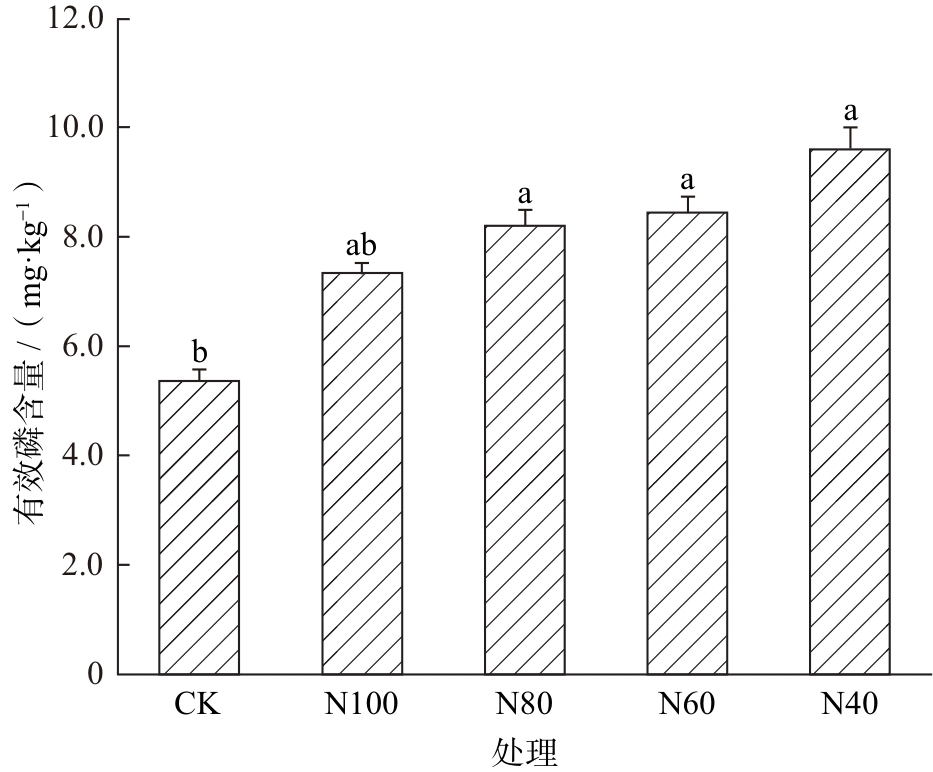
为探讨氮肥减量对紫云英还田后双季水稻产量、磷肥效率和土壤供磷能力的影响,本研究以南方双季稻种植系统为研究对象,设置无肥区(CK)、施氮肥100%(N100)、施氮肥80%(N80)、施氮肥60%(N60)和施氮肥40%(N40)等5个处理,研究不同施肥处理对水稻产量、磷吸收、磷素平衡及土壤有效磷含量的影响。结果表明:施肥提高了作物产量,N100处理的籽粒产量较CK显著(p<0.05)提高47.5%。减氮处理中,N80和N60处理的产量与N100处理无显著差异,但N40处理显著减产8.94%。N100处理的地上部总吸磷量较CK提高58.5%。随着氮肥减量,植株吸磷量和磷肥偏生产力呈下降趋势,其中N40处理的吸磷量较N100和N80分别显著减少16.1%和15.3%。磷肥偏生产力比N100、N80和N60处理显著降低了8.95%、7.32%和6.13%。施肥处理显著改善了磷素平衡,其中N100处理的磷素亏缺量减少至8.1 kg·hm-2。同时,减氮处理进一步缓解了磷素亏缺,N40处理出现盈余,达7.7 kg·hm-2。减氮处理的土壤有效磷含量较CK显著提高52.8%~79.0%,其中减氮处理的提升效果更为明显。总之,在紫云英还田条件下,将氮肥用量减少20%是可行的优化方案,这一减氮幅度既能维持水稻高产(减产幅度<3%),又能改善土壤磷素状况。

关键词: 氮肥减量, 紫云英还田, 水稻产量, 磷素利用效率, 土壤磷平衡

Abstract:

To investigate the effect of nitrogen fertilizer reduction on double-cropping rice yield,phosphorus(P)fertilizer efficiency and soil P supply capacity after returning Astragalus sinicus L. to the field,this study focused on the southern double-cropping rice system and established five treatments:no-fertilizer plot(CK),100% nitrogen application(N100),80% nitrogen application(N80),60% nitrogen application(N60),and 40% nitrogen application(N40),to examine the impacts of these different fertilization treatments on rice yield,P uptake,P balance,and soil available P content. The results showed that fertilization increased crop yield,with N100 treatment increasing grain yield significantly (p<0.05) by 47.5% compared with CK. Among the N reduction treatments,the yields of N80 and N60 showed no significant difference from N100,but the N40 treatment significantly reduced yield by 8.94%. The aboveground P uptake in the N100 treatment increased by 58.5% compared to CK. As N application decreased,plant P uptake and partial factor productivity of P fertilizer(PFP)showed a declining trend,with the N40 treatment reducing P uptake significantly by 16.1% and 15.3% compared with N100 and N80. The PFP of N40 treatment significantly decreased by 8.95%,7.32%,and 6.13% than N100,N80 and N60 treatments. Fertilization treatments significantly improved P balance,with the deficit in the N100 treatment reduced to 8.1 kg·hm-2. N reduction treatments further alleviated the P deficit,with the N40 treatment showing a surplus of 7.7 kg·hm-2. The soil available P content in fertilization treatments significantly increased by 52.8% to 79.0% compared with CK,with N reduction treatments demonstrating more pronounced improvements. In conclusion,under Astragalus sinicus L. incorporation,reducing N fertilizer application by 20% is a feasible optimization strategy. This level of N reduction maintains high rice yield(yield reduction <3%)while improving soil P status.

Key words: nitrogen fertilizer reduction, Astragalus sinicus L., rice yield, phosphorus utilization efficiency, soil phosphorus balance

中图分类号: