浙江农业科学 ›› 2026, Vol. 67 ›› Issue (8): 2055-2062.DOI: 10.16178/j.issn.0528-9017.20250382

• 农业经济与信息 • 上一篇    下一篇

福建省耕地“非粮化”的时空演变及其治理路径

翟钰颖(), 范胜龙(), 林仕杰, 蔡雨仙, 雷王致诚   

  1. 福建农林大学 公共管理与法学院,福建 福州 350002
  • 收稿日期:2025-05-23 出版日期:2026-08-11 发布日期:2026-08-20
  • 通讯作者: 范胜龙
  • 作者简介:范胜龙,E-mail:fsl@fafu.edu.cn
    翟钰颖,研究方向为土地制度与经济。E-mail:2839243356@qq.com

Spatiotemporal evolution of non-grain trend of cultivated land in Fujian Province and its governance pathways

ZHAI Yuying(), FAN Shenglong(), LIN Shijie, CAI Yuxian, LEI Wangzhicheng   

  1. School of Public Administration & Law,Fujian Agriculture and Forestry University,Fuzhou 350002,Fujian
  • Received:2025-05-23 Online:2026-08-11 Published:2026-08-20
  • Contact: FAN Shenglong

摘要:

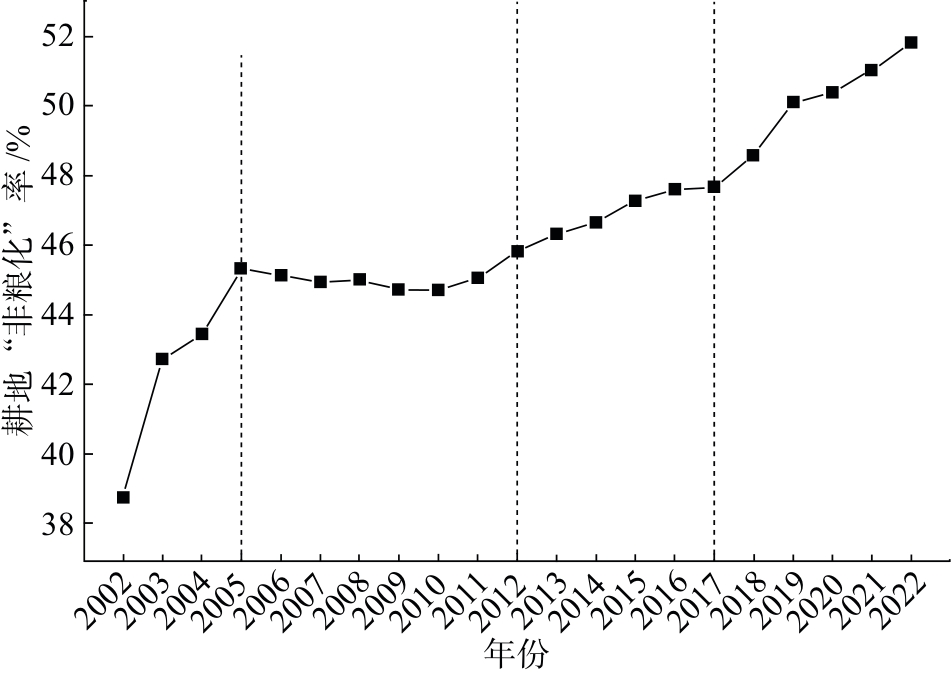
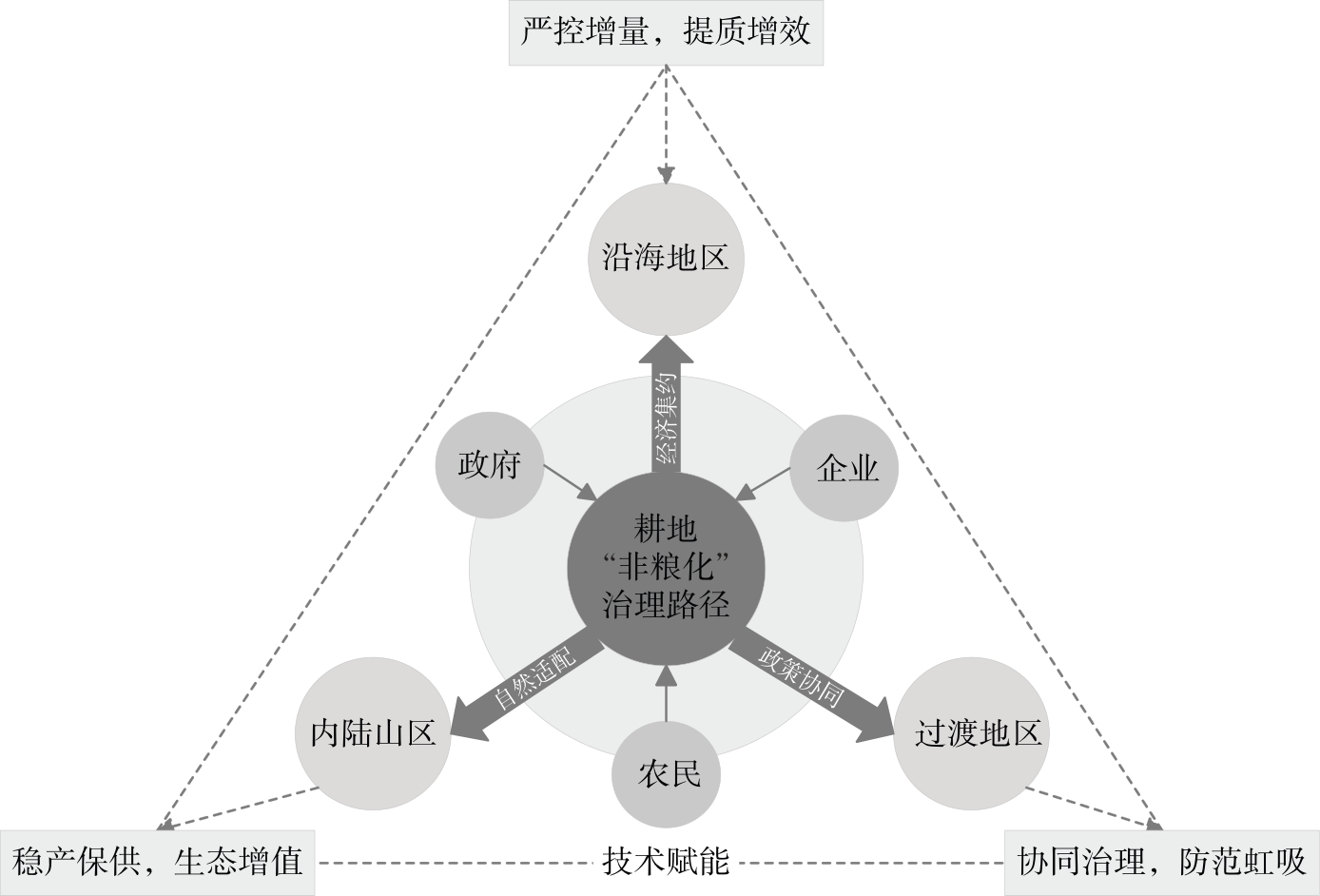
福建省耕地“非粮化”问题较为突出,揭示其时空演变规律及驱动机制,并提出相应的治理路径,对保障粮食安全与优化农业结构具有重要意义。本研究基于2002—2022年福建省县域数据,综合运用空间自相关分析及主成分分析等方法,系统解析了福建省耕地“非粮化”的时空分异特征及驱动因素,并提出了治理路径。结果表明:在时序上,耕地“非粮化”率呈显著上升趋势,可分为“快速上升”“小幅波动”“稳定增长”和“加速扩张”4个阶段;在空间上,呈现东南部高值聚集的特征,全局Moran's I指数介于0.229~0.842,局部以高-高聚集与低-低聚集为主;耕地“非粮化”主要受自然地理约束、政策制度、经济因素和城乡发展的综合影响,其核心影响因素为自然地理约束及经济社会发展水平。基于上述结果,提出以“自然适配、经济集约、政策协同、技术赋能”为核心的治理路径。通过实施差异化的管理措施,有助于实现福建省耕地保护与区域经济社会发展之间的动态平衡,为国家粮食安全战略下耕地保护政策的优化调整提供参考。

关键词: 耕地“非粮化”, 时空变化, 主成分分析, 灰色关联分析, 福建省

Abstract:

The non-grain trend of cultivated land in Fujian Province is particularly prominent. Revealing its spatiotemporal evolution patterns and driving mechanisms,and proposing corresponding governance pathways,is of great significance for ensuring food security and optimizing agricultural structure. Based on county-level data of Fujian Province from 2002 to 2022,this study systematically analyzed the spatiotemporal differentiation characteristics and driving factors of the non-grain trend of cultivated land in Fujian Province using methods such as spatial autocorrelation analysis and principal component analysis,and proposed governance pathways. The results showed that, temporally,the non-grain rate exhibited a significant upward trend,which could be divided into four stages: rapid rise, slight fluctuation, steady growth,and accelerated expansion. Spatially,the non-grain trend of cultivated land showed a high-value clustering characteristic in the southeast,with the global Moran's I index ranging from 0.229 to 0.842,and the local patterns being dominated by high-high and low-low clusters. The non-grain trend of cultivated land was mainly influenced by the combined effects of physical geographical constraints,policy systems,economic factors,and urban-rural development,with the core influencing factors being physical geographical constraints and the level of economic and social development. Based on the above findings,a governance pathway centered on "natural adaptation,economic intensification,policy coordination,and technology empowerment" is proposed. The implementation of differentiated management measures will help achieve a dynamic balance between cultivated land protection and regional economic and social development in Fujian Province,providing a reference for optimizing and adjusting cultivated land protection policies under the national food security strategy.

Key words: non-grain trend of cultivated land, spatiotemporal change, principal component analysis, grey relational analysis, Fujian Province

中图分类号: